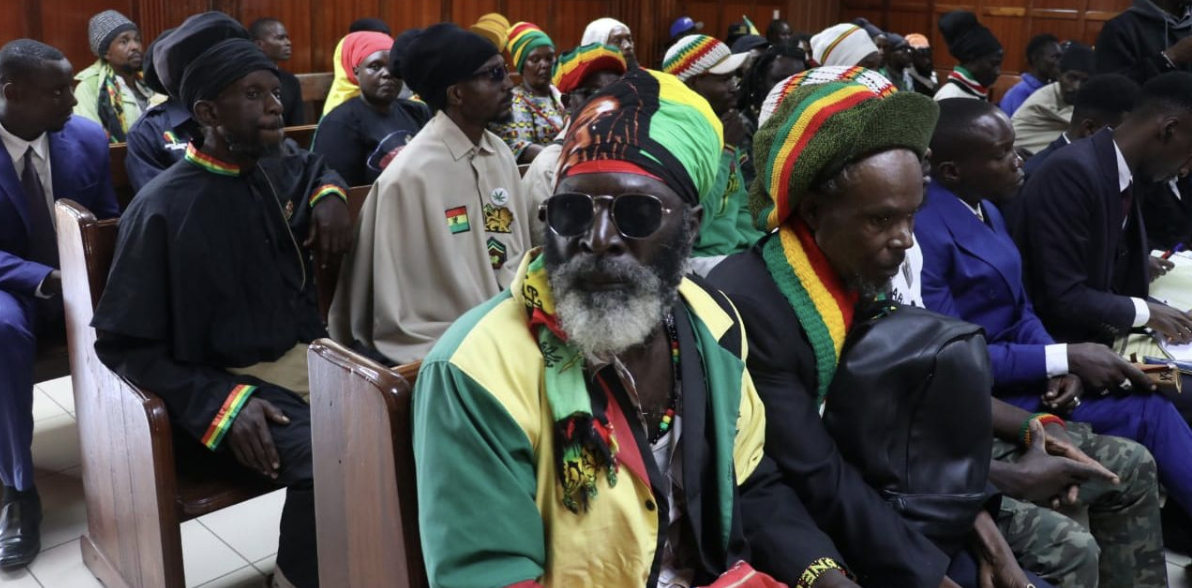
Kenya’s debate over marijuana legalization is headed for a historic turning point after the High Court reserved judgment for May 28, 2026, in a controversial petition seeking to allow the use of cannabis for religious purposes by members of the Rastafarian Society of Kenya.
The petition, filed through lawyers Shadrack Wambui, Danstan Omari and Matina Swigga, has ignited sharp national debate over religious freedom, public health, morality and drug policy in Kenya.

During final submissions before the High Court, lawyers representing the Rastafarian community argued that marijuana commonly referred to as cannabis or “bhang” in Kenya is a sacred element of Rastafarian worship and spiritual practice. They told the court that criminalizing its use violates constitutional protections on freedom of religion and discriminates against a minority faith group.
The petitioners further argued that Rastafarians in Kenya have for years suffered harassment, intimidation and profiling by police officers because of their dreadlocks, attire and religious identity. According to the society, members are frequently targeted during arrests and police crackdowns despite practicing what they describe as a peaceful faith rooted in spirituality, African identity and natural living.
To address concerns about abuse, the society told the court it has developed internal mechanisms to regulate who may use cannabis and under what circumstances. The petitioners also proposed that marijuana consumption be limited to controlled private settings linked to worship practices.
However, the state strongly opposed the application, warning that legalizing marijuana even on religious grounds could create dangerous legal loopholes and undermine anti-drug enforcement efforts.
Government lawyers argued that scientific and forensic studies conducted globally have linked marijuana abuse to severe mental health complications, addiction risks and impaired judgment. They maintained that cannabis remains illegal in Kenya under the Narcotic Drugs and Psychotropic Substances Control Act and emphasized that many countries continue to restrict or criminalize its use despite growing legalization movements elsewhere.
The state also faulted the Rastafarian Society for allegedly failing to clearly define the quantity of marijuana members would be permitted to consume or how such use would be monitored and controlled. Prosecutors further questioned the proposal to restrict consumption to “private places,” arguing that places of worship cannot automatically be classified as private spaces accessible only to authorized individuals.
Background to the Case
The case comes amid growing global shifts on marijuana policy. Countries such as Canada, Jamaica, South Africa and parts of the United States have relaxed laws governing cannabis use, particularly for medicinal, personal or religious purposes.
In 2018, South Africa’s Constitutional Court ruled that adults could privately use cannabis, a landmark decision that fueled similar conversations across Africa. Jamaica, where Rastafarianism has deep cultural and religious roots, also decriminalized limited use of marijuana for sacramental purposes.
In Kenya, however, possession, cultivation and trafficking of cannabis remain criminal offenses punishable by heavy fines and lengthy prison sentences. Despite this, activists and some lawmakers have occasionally pushed for partial legalization, especially for industrial hemp and medicinal use, arguing that cannabis could generate tax revenue and create jobs if properly regulated.
The pending High Court decision is therefore expected to become one of the most closely watched constitutional and cultural rulings in recent Kenyan history, with major implications for religious liberty, minority rights and the country’s future approach to marijuana laws.