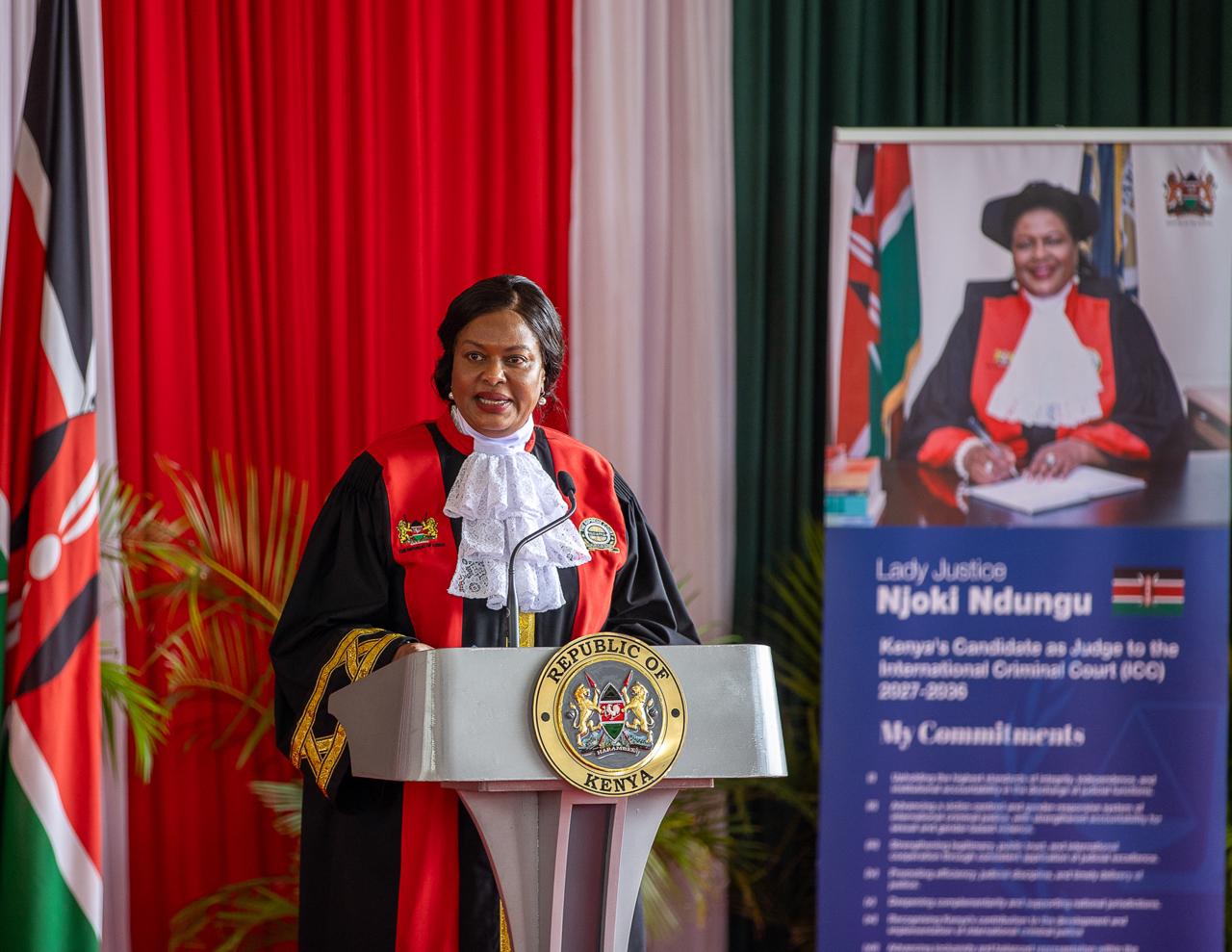
Kenya has officially launched the candidature of Supreme Court Judge Njoki Ndung’u for election as a judge of the International Criminal Court (ICC) for the 2027–2036 term, with President William Ruto pledging full government backing for her bid.

Speaking during the unveiling ceremony at State House, Nairobi, Ruto said the government will mount a coordinated diplomatic campaign to secure Ndung’u’s election, describing her as one of Kenya’s most distinguished legal minds with extensive experience in law, governance and international affairs.
“I have listened very carefully to the track record of Njoki Ndung’u and also listened to her vision at the ICC. They are persuasive, coherent and meaningful,” Ruto said. “At a personal level and on behalf of the government, you have our endorsement, support, and we are going to campaign for you.”
He added that Ndung’u’s candidature goes beyond personal achievement, framing it as an opportunity for Africa to influence global justice systems. “This is not just an election, it is also an opportunity for Ndung’u to speak and give an African perspective and bring African experience to international justice,” he said.
Chief Justice Martha Koome, who also attended the event, said Ndung’u’s bid reflects the growing credibility of Kenya’s judiciary on the global stage. She noted that stronger African representation at the ICC would ensure the continent’s legal experiences are reflected in international jurisprudence, particularly in areas such as constitutional transformation, accountability, and restorative justice.
In her remarks, Ndung’u expressed gratitude for the nomination, saying her candidacy is grounded in a lifelong commitment to justice and the rule of law.
“I am proud to seek this position as a Kenyan who has dedicated her professional life to the service of justice and the rule of law,” she said.
She outlined her guiding principles as courage, efficiency, pragmatism, victim-centred justice and an African-focused approach to international jurisprudence, adding that Africa’s legal experience must be better integrated into the ICC system.
Ndung’u acknowledged long-standing concerns over Africa’s relationship with the court, stating: “Africa has often carried the weight of ICC scrutiny, sometimes accompanied by perceptions of bias.”
She pledged to work toward strengthening the ICC’s engagement with African states and ensuring the continent’s legal perspectives are more firmly embedded in its jurisprudence.
Ndung’u brings decades of legal and governance experience, having served in Parliament, the Pan-African Parliament, and as part of the Committee of Experts that drafted Kenya’s 2010 Constitution. She has also held roles in international and humanitarian organisations, alongside a judicial career at Kenya’s Supreme Court, where she oversees governance and regulatory affairs.
She is widely recognised for her contribution to key legal reforms, including the Sexual Offences Act and amendments to labour and political party laws.