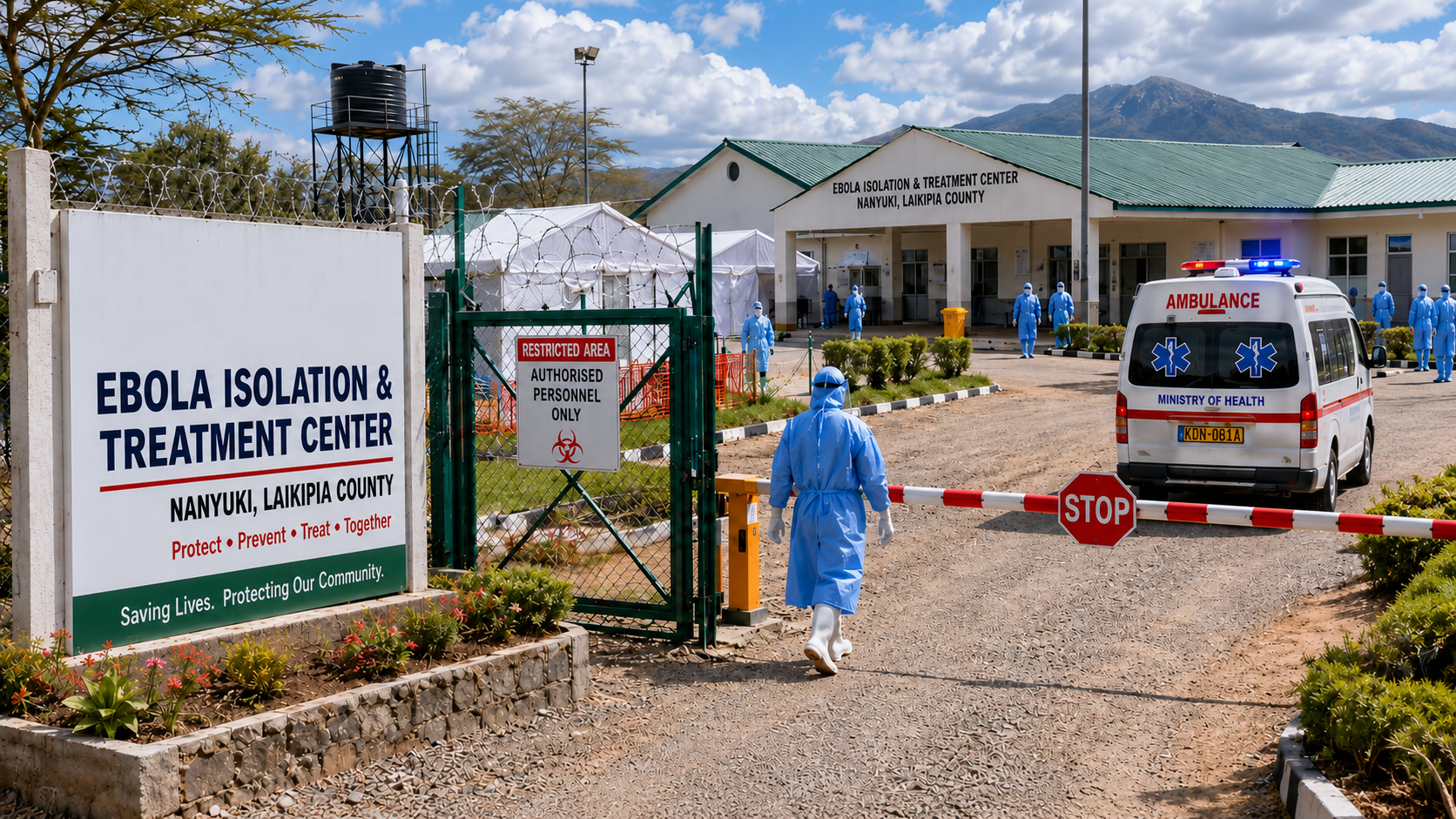
The County Government of Laikipia has formally opposed the proposed establishment of an Ebola Quarantine and Isolation Facility within the county, arguing that the project raises significant concerns relating to public health, governance, tourism and the welfare of children.
In a replying affidavit filed in court, Laikipia County Executive Committee Member for Health Albert Taiti says while the county supports efforts aimed at strengthening preparedness for infectious disease outbreaks, it has serious reservations about the manner in which the proposed facility is being implemented.


Taiti states that the facility is intended to be established within Laikipia County and will directly affect residents, public institutions, emergency response systems and county governance structures.
According to the county government, Laikipia already faces challenges in financing community health services and lacks sufficient capacity to respond to a major infectious disease outbreak.
“The 4th Interested Party fully appreciates the primacy of national public health preparedness measures aimed at preventing, detecting and responding to infectious disease outbreaks and public health emergencies,” Taiti states in the affidavit.
However, he argues that decisions involving a high-risk disease such as Ebola must be guided by transparency, scientific assessment, stakeholder engagement and strict compliance with constitutional requirements.
The county contends that the proposed facility poses potential risks to residents’ right to the highest attainable standard of health under Article 43 of the Constitution and raises questions regarding pathogen containment, emergency preparedness and public safety.
A key concern raised by the county is the alleged lack of meaningful consultation by the National Government before identifying and announcing the proposed site.
According to Taiti, Laikipia County was not adequately involved in site selection, risk assessment, contingency planning or emergency response coordination despite constitutional provisions requiring cooperation between national and county governments.
“The absence of meaningful consultation undermines the principles of cooperative governance and devolution as entrenched in the Constitution,” he states.
The county has also warned of possible economic consequences, particularly on the tourism sector, which it says is a critical pillar of the local economy.
Taiti notes that Nanyuki Town, located approximately eight kilometres from the proposed site at Laikipia Air Base, serves as a major tourism and commercial hub. He adds that Laikipia is home to internationally recognised attractions such as Ol Pejeta Conservancy, Ol Jogi Conservancy and Mount Kenya National Park.
According to the affidavit, some hotels have already reported booking cancellations following reports about the planned Ebola facility.
The county argues that any disruption to tourism could lead to job losses and negatively affect thousands of residents who depend on the sector for their livelihoods.
Laikipia County has also raised concerns about the location of the proposed facility within the Kenya Air Force Base in Nanyuki, where Laikipia Airbase Primary School and Laikipia Airbase Junior School are located.
The county says the schools serve both children of military personnel and civilians from surrounding communities and questions whether adequate child protection measures were considered before the site was selected.
According to Taiti, no sufficient information has been provided to demonstrate that child impact assessments, school safety evaluations, emergency evacuation plans or child-specific risk management measures were conducted.
“Article 53(2) of the Constitution requires that the best interests of the child shall be of paramount importance in every matter concerning the child,” he states.
The county further argues that residents have not been provided with adequate information regarding the scientific basis for the site’s selection, the proposed risk mitigation measures and long-term public health safeguards associated with the project.
Laikipia also questions whether meaningful public participation was undertaken before the project was announced, maintaining that constitutional principles require engagement with communities likely to be affected.
The county is now urging the High Court to subject the proposed facility to thorough judicial scrutiny and ensure compliance with constitutional requirements relating to public participation, intergovernmental consultation, public health safeguards and the precautionary principle.
Taiti says the welfare of schoolchildren within the airbase and the broader interests of Laikipia residents should be fully protected before any decision is made on the proposed Ebola Quarantine and Isolation Facility.