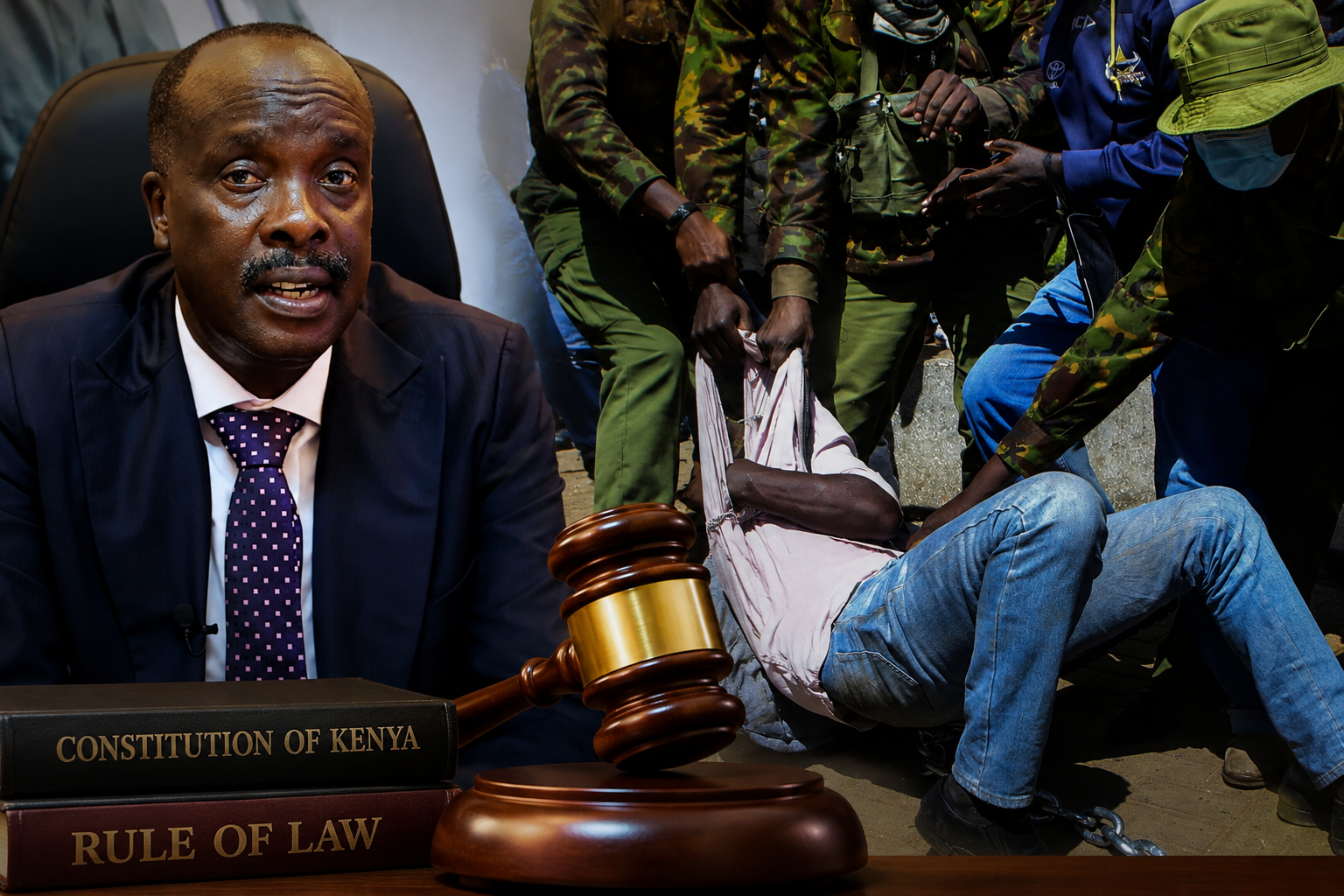
Lawyer Danstan Omari has cited a landmark high Court decision, later upheld by the Court of Appeal, to argue that state officers who abuse state power risk being held personally liable for their actions instead of hiding behind the offices they occupy.
In an explainer, Omari said the judgment sends a strong warning to all public officials, including Principal Secretaries, the Inspector General of Police, Directorate of Criminal Investigations (DCI) officers and other law enforcement personnel, that political office is temporary but the rule of law is permanent.


Omari questioned the Government’s continued denial of involvement in alleged abductions, saying many Kenyans find the explanation difficult to believe.
“The question every Kenyan is asking is, how can somebody abduct himself, beat himself up, injure himself, cause serious bodily harm, take himself to Kenyatta National Hospital, admit himself and then be found after several days?” Omari posed.
He said the controversy illustrates why public officers must exercise their powers strictly within the Constitution and the law. Omari anchored his analysis on a decision by Judge Joel Ngugi, delivered while he was serving in the High Court in Nakuru. The case involved six Nakuru residents who were arrested, detained beyond the constitutional 24-hour limit and later charged with an offence. The trial court eventually acquitted them after finding that the prosecution had failed to establish a prima facie case. The six later filed a constitutional petition against the then Rongai District Commissioner Joseph Motari Mosigisi, the District Criminal Investigations Officer and other State officials, claiming they had been unlawfully arrested and maliciously prosecuted.
Justice Ngugi found that the petitioners had suffered unlawful detention, humiliation and emotional distress after being accused of exhuming and desecrating a body. He awarded each of the six petitioners Sh 800,000 in compensation. When the officials sought a review of the judgment, Justice Ngugi declined and delivered what has since become one of Kenya’s leading pronouncements on accountability in public office.
He held that a public servant who steps outside the lawful limits of his office and maliciously harms citizens loses the legal protection ordinarily attached to public office and should personally bear the consequences of those actions. The judge further reminded public servants that the authority vested in them exists to serve the public and must always be exercised in accordance with the Constitution, the law and their oath of office. He cautioned public officers against using State power to target citizens simply because they are perceived to be on the wrong side of the prevailing political establishment.
Justice Ngugi also delivered a warning that Omari said every public officer should remember.
According to the judge, political power and public office are transient, they come and go, but the rule of law is enduring under the Constitution. The decision was appealed by the then District Commissioner, Joseph Motari Mosigisi, but the Court of Appeal dismissed the appeal in March 2026, affirming both the compensation awarded to the victims and the legal principle that public officers who abuse their authority may be personally liable for the harm they cause.
Omari said the appellate court’s decision now firmly establishes that public officers cannot rely on their official positions as a shield against accountability. He said the judgment should serve as a wake-up call to Cabinet Secretaries, Principal Secretaries, police officers, prison officers, DCI investigators and every public servant entrusted with state authority.
According to Omari, anyone exercising public power must understand that while appointments and political influence are temporary, the law outlives every administration.
“The Court of Appeal has affirmed that if you misbehave as a public officer, if you abuse your office and fail to follow the rule of law, you can be held personally liable,” Omari said.
He argued that the decision reinforces the constitutional principle that public office is a public trust, not a licence to violate the rights of citizens without consequences.