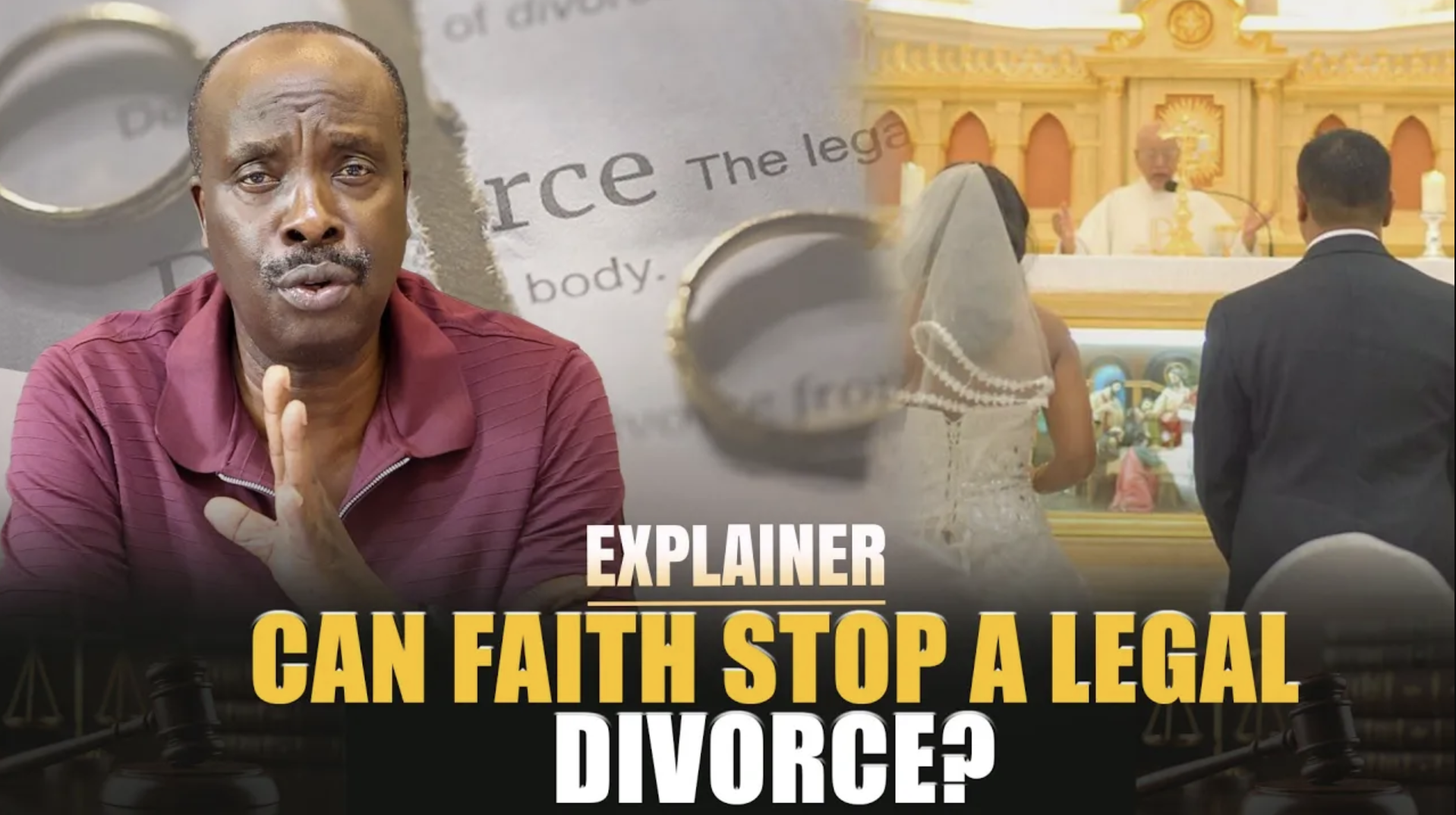
A recent High Court ruling affirming that Catholic marriages can be dissolved under Kenya’s civil laws has reignited debate about the relationship between faith, marriage and individual freedoms.
The judgment, delivered on June 17, 2026, arose from a constitutional petition filed by Peter Kimari Gathirimu, a practicing Catholic who challenged the legality of divorce proceedings initiated by his wife, Mary Wanjiku Wambui.


According to the petitioner, Catholic doctrine treats marriage as a lifelong union that cannot be dissolved, and therefore requiring him to participate in divorce proceedings violated his constitutional right to freedom of religion. However, the High Court dismissed the petition, finding that while religious beliefs are protected under the Constitution, they cannot override a spouse’s right to seek legal remedies available under Kenyan law.
Commenting on the decision, lawyer Danstan Omari described the ruling as a significant clarification of the relationship between religious doctrine and civil law.
“The court is saying marriage is not a prison,” Omari explained. “Religion should not be used to detain somebody in a marriage that is no longer working.”
The advocate noted that the dispute arose after a Catholic couple, married in church in 2019, found themselves before the courts when the wife sought divorce. While the husband argued that divorce was contrary to Catholic teaching, the court held that Kenyan law applies equally to all citizens regardless of religious affiliation.
“The judge found that exempting Catholics from divorce proceedings would itself amount to discrimination,” Omari said. “Article 27 of the Constitution guarantees equality before the law, and Catholics cannot be denied remedies that are available to other Kenyans.”
One of the most striking aspects of the judgment was the court’s detailed examination of biblical scripture. The judge referenced Amos 3:3, which asks, “Do two walk together unless they have agreed to do so?”, to emphasize that marriage requires continuous mutual commitment and shared purpose.
“The judge went beyond the law and looked at the Bible itself,” Omari observed. “The message was that marriage is not simply the day people exchange vows. It is an ongoing commitment that requires agreement, cooperation and mutual respect.”
The court also cited passages from the Gospel of Matthew and the First Letter to the Corinthians, concluding that while the Bible does not encourage divorce, it recognizes circumstances under which separation may occur.
According to the judgment, grounds such as adultery and abandonment are acknowledged both in scripture and under Kenya’s Marriage Act. The court further rejected the argument that wedding vows constitute a permanent waiver of a citizen’s legal rights.
“A marriage vow, however sacred, cannot prevent a person from accessing the courts,” Omari explained. “The right to seek justice, safety and personal autonomy cannot be signed away forever.”
In dismissing the petition, the court also declined to incorporate Catholic canon law into Kenya’s statutory legal framework. The judge held that the High Court could not transform itself into an ecclesiastical tribunal tasked with enforcing church doctrine.
“The court was very clear,” Omari said. “If the Catholic community wishes to have a separate legal framework governing marriage and divorce, that conversation belongs in Parliament, not in the courts.”
In one of its most quoted passages, the court stated that ending a marriage should not automatically be viewed as a failure.
“Recognising marriage as a flexible and respectful institution allows for compassion and dignity for those facing unfulfilled or harmful relationships,” the judgment reads.
Omari said the court appeared keen to challenge the social stigma often associated with divorce.
“Many people suffer in silence because they fear society’s judgment,” he said. “The court is saying that where a marriage has become harmful, the law provides a lawful exit. Protecting human dignity sometimes means allowing people to walk away.”
With the petition dismissed, the High Court has reaffirmed that while religious beliefs remain protected, no spouse can be compelled to remain in a marriage solely because their partner objects to divorce on theological grounds.
In a nutshell, faith remains a matter of personal conviction, but marriage under Kenyan law remains subject to the Constitution and the protections it guarantees every citizen.