
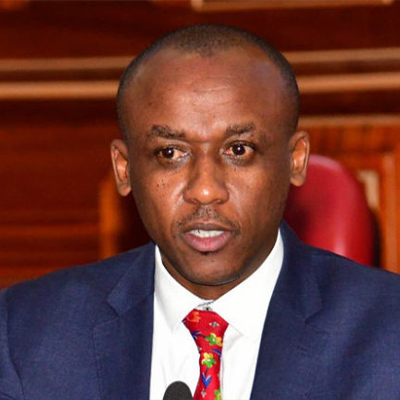
Makueni Governor Mutula Kilonzo Jr. has called for the development of clear regulations governing the use of Artificial Intelligence (AI) in Kenya’s legal profession, warning that uncontrolled reliance on the technology could undermine the administration of justice.
Speaking during the LSK Annual conference 2026, the governor, said lawyers were increasingly using AI in legal research and court filings, sometimes with serious consequences.


He said there have been instances where lawyers relied on AI-generated information and ended up citing incorrect or non-existent cases.
“We must find a formula, even in the practice of this profession, where we have a strict policy on how, up to what extent, can you use AI,” Kilonzo said.
He urged the Law Society of Kenya (LSK) to formulate regulations governing the use of AI by lawyers, including requirements for disclosure whenever the technology is used in legal work.
According to Kilonzo, the absence of clear rules could expose the justice system to cases founded on inaccurate precedents, potentially affecting court decisions for years. He noted that precedents are a cornerstone of the legal profession and courts, particularly under the doctrine of stare decisis, where lower courts are generally bound by decisions of higher courts.
“Technology has moved faster than law,” he said, calling for regulations with enforceable penalties for the misuse of AI in legal practice.
Kilonzo also raised concerns over the growing mental health challenges facing young advocates, attributing them partly to the pressure and demands of the legal profession. He said the issue had been discussed by both the senior and junior bars, with growing concern that young lawyers were struggling to cope with professional and personal pressures. He called on experienced lawyers to take greater responsibility in mentoring young advocates and helping them navigate the profession.
“The legal profession has expanded tremendously. The legal work and the pressure amongst ourselves, of course, has increased, and therefore it is important that we mentor young lawyers,” he said.
Kilonzo urged young advocates to understand that building a successful legal career takes time, emphasizing the importance of establishing a good professional reputation. He said senior lawyers had an obligation to guide younger practitioners and help them understand that success in the profession cannot always be achieved immediately. The Governor further encouraged lawyers, particularly young advocates, to take an active role in public interest litigation.
He said public interest cases provide an important avenue for lawyers to defend issues affecting society, including governance, corruption and policies that may adversely affect the public. Kilonzo said public interest litigation also provides young lawyers with an opportunity to demonstrate their legal skills while contributing to society.
He noted that courts often do not award costs in public interest cases, but argued that this should not discourage advocates from taking up matters that protect public interests. The conference also addressed financial reporting and the risk of law firms being used to facilitate money laundering.
Kilonzo said advocates needed to undertake proper due diligence and know their clients before handling funds through their accounts. He said lawyers had been sensitised on financial reporting requirements and the need to ensure that funds passing through law firms were legitimate. He warned that failure by advocates to conduct proper due diligence could expose the profession and the country to serious financial crimes.
Kilonzo also spoke strongly about the protection of fundamental rights and the independence of the Judiciary. He said Kenya had a robust constitutional framework protecting rights including the right to life, human dignity, freedom of expression, association, assembly and the media.
However, he expressed concern over reports of abductions, excessive use of force and killings, arguing that such incidents undermine constitutional protections. He said lawyers must continue defending constitutional rights and ensuring that government institutions remain accountable. Kilonzo particularly warned against the failure to obey court orders, saying the Executive must respect decisions issued by the Judiciary.
He cited orders stopping the construction of a quarantine facility in Nanyuki as an example, stressing that a court order must not be treated as a mere suggestion.
“An order cannot be a suggestion,” he said.
Kilonzo warned that continued disregard of court orders could undermine public confidence in the Judiciary and weaken the rule of law.
He argued that Kenya must not return to an era where citizens’ freedoms were subject to the discretion of the Executive.
“The Executive must understand that the rule of law is paramount in Kenya, and everybody is subject and is not above the law,” he said.
He further warned that failure to enforce judicial orders could create a perception that the Judiciary is merely an appendage of the Executive.
Kilonzo said the issues raised during the conference, including the welfare of lawyers, the use of AI, public interest litigation, relations between the Bar and Judiciary, and protection of fundamental rights, were expected to form part of resolutions to be adopted by the Law Society of Kenya at the end of the conference.