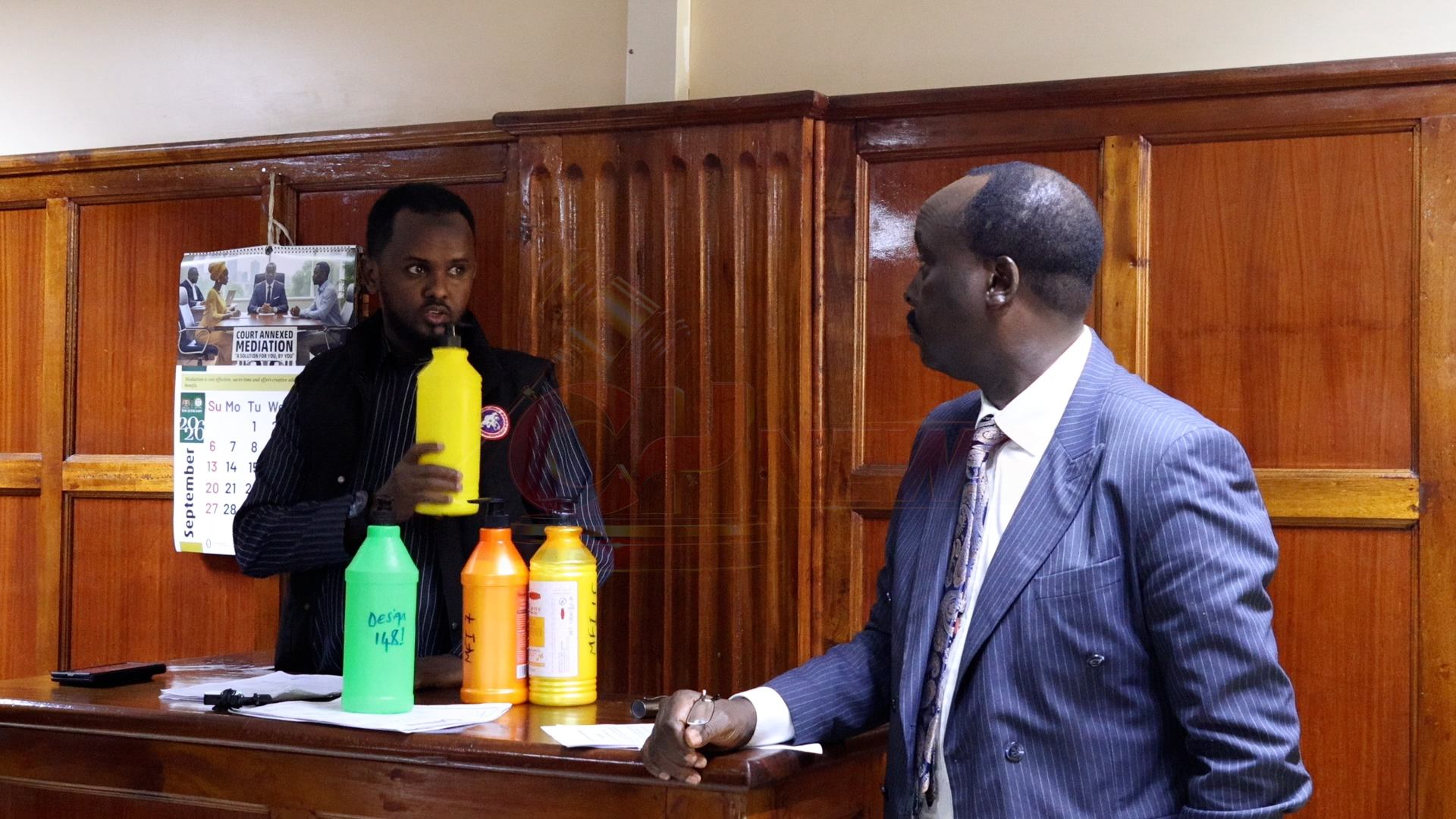
A Rapid Cosmetics Enterprises Limited designer on Monday told the Milimani Law Court how he came across shampoo bottles he alleged had imitated designs he created for the company, as lawyer Dunstan Omari questioned the similarities between the disputed products and the company’s designs.
Mohamed Ahmed Noor, a sales marketer and designer at Rapid Cosmetics, testified as the complainant’s witness in a case in which Mohamed Abdirizak Farah and Mariya Group Limited face eight counts under the Anti-Counterfeit Act over the alleged manufacture, possession and distribution of products said to imitate Rapid Cosmetics’ Industrial Designs Nos. 1480 and 1481.


Noor told the court that he started designing for Rapid Cosmetics in 2017 and was involved in creating the two shampoo bottle designs, which were later registered with the Kenya Industrial Property Institute (KIPI).
He explained that the bottles had distinguishing features including their shape, rings, necks, covers and markings. Noor said he later came across two bottles in the market which he believed resembled the designs he had created. “I found two samples which were similar to our designs,” Noor told the court. He identified one bottle as imitating Design No. 1481 and another as imitating Design No. 1480.
The witness said he took the samples to Rapid Cosmetics director Nasi, who referred the matter to the Anti-Counterfeit Authority. Noor also identified a bottle produced in court as a Mariya Group Limited product, saying it imitated Design No. 1480. He told the court that he was subsequently called upon by the Anti-Counterfeit Authority to analyse the samples and prepare a report comparing them with Rapid Cosmetics’ designs.
During cross-examination, Omari questioned Noor about how he came up with the disputed designs and whether Google had been used in the process. Noor maintained that the designs were his work, while acknowledging that Google had been used.
Omari then turned his attention to the physical features of the bottles, asking Noor to demonstrate the differences in their markings, rings and measurements. The exchange drew laughter in court as the lawyer repeatedly pressed the witness to identify exactly what made the bottles similar or different. At one point, Omari challenged Noor over the alleged similarities, with the witness acknowledging that there were differences between the bottles. “They are different,” Noor told the court during the exchange.
Omari also questioned Noor on the identification of the bottles produced in court, including whether they belonged to Rapid Cosmetics or Mariya Group Limited. Noor identified the disputed products as Mariya Group bottles.
The case relates to allegations that 8,256 bottles imitating Industrial Design No. 1481 were manufactured and possessed at Viken Industrial Park on April 6, 2023. The bottles are valued at Sh3,451,008 according to the current charge sheet. The accused are also charged over 792 bottles allegedly imitating Industrial Design No. 1480 and valued at Sh331,056. The prosecution further alleges that two metallic moulds, each valued at Sh400,000, were found and allegedly imitated the registered designs.
Another two counts relate to 266 bottles allegedly imitating Design No. 1481, valued at Sh111,188, which the prosecution says were distributed and manufactured at Sihan Mall, Eastleigh. The eight charges include manufacturing, possession, possession of moulds and distribution of goods allegedly imitating Rapid Cosmetics’ registered designs.
The hearing will resume on October 15 when the prosecution is expected to continue presenting its evidence.