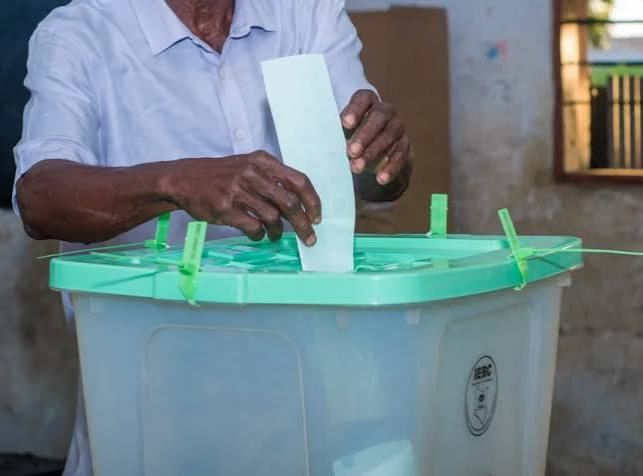
A petitioner has moved to the High Court seeking orders requiring the Independent Electoral and Boundaries Commission (IEBC) to disclose how key aspects of the 2027 General Election will be organised, including the location of polling and tallying centres and procedures for identifying voters.
Francis Awino has filed a constitutional petition together with a Notice of Motion in which he argues that voters and other election stakeholders should have access to critical information on the electoral process well before polling day.


At the centre of his case is the question of what information the IEBC has already prepared, approved or designated for the next General Election. For instance, Awino wants the Commission to state whether it has already identified a national tallying centre and, if so, disclose its name, physical location, geographical coordinates, legal basis, designation details and any Gazette Notice relating to it.
He is also asking for information on how the facility would be managed, including the procedures to be followed during tallying, verification, record keeping, auditing and access by the public and other election stakeholders.
In seeking the information, Awino argues that the national tallying centre is an important component of the electoral process and that its arrangements should be known in advance rather than emerging during or after the election. “The national tallying centre is a constitutionally material link in the electoral process,” the petitioner states in his case.
Beyond the tallying centre, the petitioner has turned his attention to the physical locations where Kenyans will cast their votes and where results will be tallied. He wants the IEBC to disclose details of polling stations and tallying centres, including their designation, exact location, accessibility and the manner in which members of the public will be notified.
Awino is asking the court to require the Commission to publish the precise geographical coordinates of the facilities at least six months before the General Election. He says the advance publication would give voters, candidates, political parties, agents and observers an opportunity to establish where the facilities are located and raise any concerns before election preparations reach the final stages.
The petitioner has also raised questions about voter identification, particularly the procedures that would apply where biometric verification does not work. According to his application, the IEBC should disclose the protocol it intends to use when a voter’s biometric details cannot be read, when an electronic device malfunctions or when connectivity problems interfere with the verification process.
He argues that any alternative method should be clearly documented so that its use can subsequently be examined and audited. “Biometric voter verification is the most objective, accurate and auditable primary process,” Awino says in his supporting affidavit. Consequently, he wants the IEBC to disclose any manuals, circulars, standard operating procedures, directions, training materials, internal correspondence and decision records relating to voter identification and verification.
The petitioner is further seeking an order requiring the Commission to explain what it has done following a written request he made on September 16, 2026, in which he sought information concerning the electoral arrangements. He wants the IEBC to file an affidavit setting out the status of the national tallying centre and confirming whether written protocols exist for its operation and for voter identification and verification.
Awino is also asking the court to restrict the IEBC from making undisclosed or materially different changes to the arrangements governing the national tallying centre and voter verification while the case is pending.
Similarly, he wants any decision to designate, relocate, alter or de-gazette a polling station or tallying centre to comply with the Constitution and electoral laws. He proposes that where such changes become necessary, the IEBC should preserve the reasons for the decision, the legal authority relied upon, the decision-making record and evidence showing that the public was notified.
The petitioner has anchored his challenge on several constitutional provisions dealing with political rights, access to information, fair administrative action and the management of elections. He has also cited the Elections Act, the IEBC Act and various electoral regulations in support of his case.
In making his argument on the national tallying process, Awino has relied on the Court of Appeal’s 2017 decision in the Maina Kiai case. That decision addressed the status of presidential results declared at polling stations and constituency tallying centres, with the appellate court holding that such results were final and could not be varied by the IEBC chairperson at the national tallying centre.
However, while Awino has asked the court to treat the matter as urgent, Justice R.E. Aburili has declined to grant the request. “I find no urgency disclosed in petition, notice of motion and the certificate of urgency,” Justice Aburili stated in her September 21, 2026 directions. The judge instead directed Awino to serve the petition and Notice of Motion on the IEBC, its chairperson, the Attorney General and the Law Society of Kenya, which is an interested party in the case.
Following service, the respondents and interested party have 15 days to respond. Awino will thereafter have 15 days to file any further affidavit and written submissions, while the respondents may file supplementary affidavits and submissions.
The case will return to the High Court on November 9, 2026, when the court is expected to give further directions on the hearing of the petition and the application for conservatory orders.