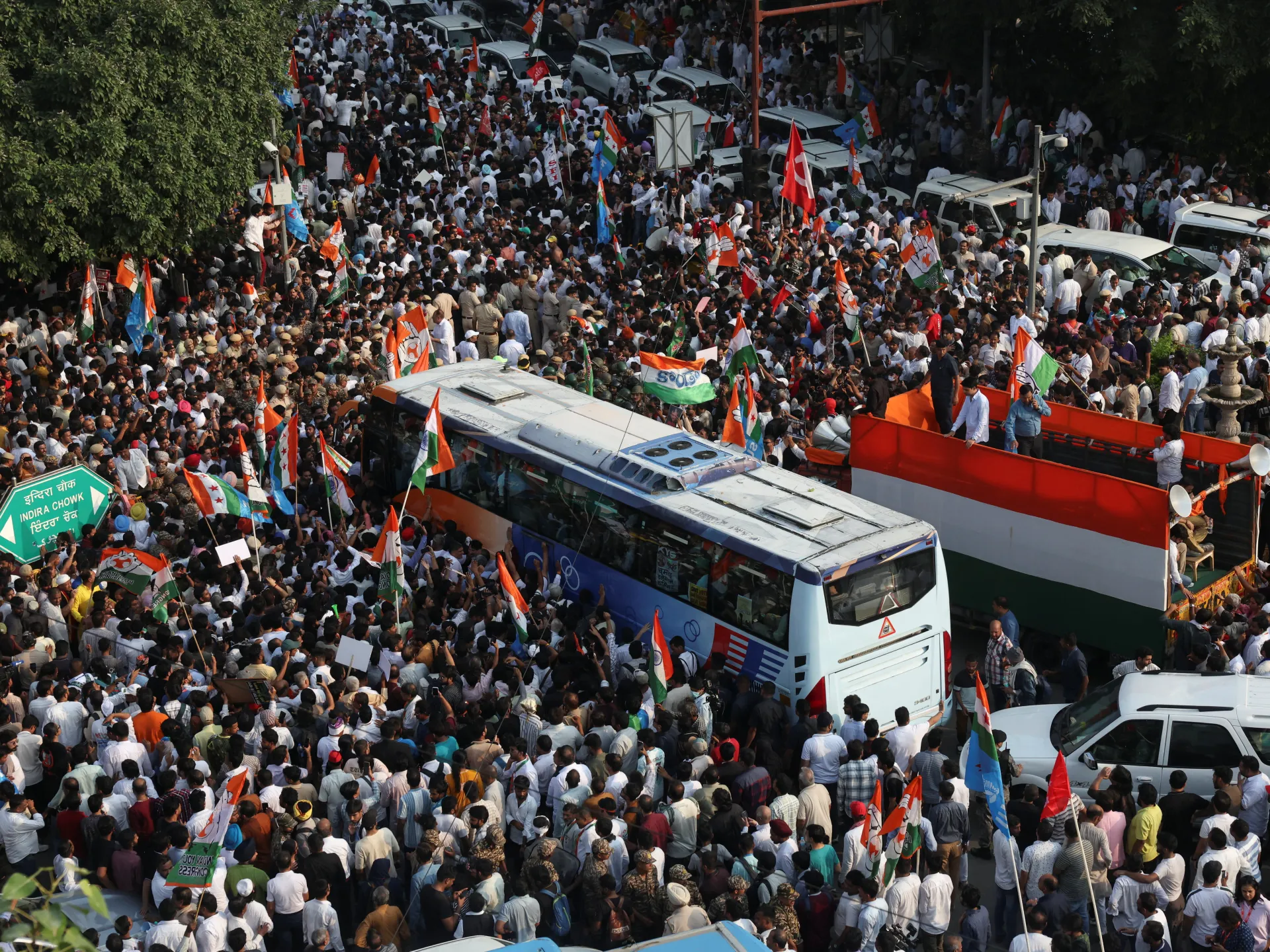
Thousands of opposition supporters in India marched to the Supreme Court on Monday, challenging changes to voter registration lists and seeking an immediate suspension of the exercise.
The demonstration comes amid growing political tension in the country, with opposition parties demanding the resignation of Chief Election Commissioner Gyanesh Kumar over the voter list revision, which critics claim could benefit Prime Minister Narendra Modi’s Bharatiya Janata Party (BJP).


The exercise, which began last year, has resulted in more than 130 million names being removed from voter registers. The deletions include approximately 28 million deceased individuals, 63 million people who had relocated and 30 million others who could not be traced.
Monday’s march covered about seven kilometres through central Delhi before reaching the Supreme Court. Protesters carried party flags and chanted slogans calling for Kumar to step down. The demonstration remained peaceful under heavy security, following a police crackdown over the weekend that saw thousands of protesters detained, including leaders of the Cockroach Janta Party (CJP).
The petition filed by opposition groups is expected to come before the Supreme Court on Tuesday. Among its signatories is opposition leader Rahul Gandhi. The petition seeks an independent audit of the deleted voter records, safeguards against removals without prior notification and an opportunity for affected individuals to be heard. It also calls for the nationwide suspension of the voter list revision as the legal challenge proceeds.
The Election Commission has denied allegations of political bias, maintaining that voters whose names were wrongly removed can register again. The BJP has accused opposition parties of undermining democratic institutions by questioning the legitimacy of the electoral process.
Monday’s demonstration attracted opposition party members and left-wing student groups. Anirudh Siyag, a doctoral student who participated in the march, said he had joined the protest because he believed the country’s fundamental values and institutional independence were under threat.
The BJP dismissed the demonstrations, accusing the opposition Congress party of using the dispute to regain political power. Agriculture Minister Shivraj Singh Chouhan accused opposition leaders of discrediting constitutional institutions and creating disorder for political gain.
Meanwhile, Delhi Police announced that Jantar Mantar, a historic site in central Delhi long associated with public demonstrations, would no longer serve as an officially designated protest venue. Authorities said three alternative locations had been identified. The CJP had previously held a weeks-long sit-in at Jantar Mantar over allegations of examination paper leaks, demanding the resignation of Education Minister Dharmendra Pradhan.
Separately, CJP leaders met police officials to seek a date for another peaceful demonstration. They warned that they could announce fresh protests if authorities failed to provide a date within 24 hours. The youth-led CJP movement has organised demonstrations in recent months over issues including unemployment, school infrastructure and alleged examination irregularities. Its growing mobilisation has added to the political pressure facing Modi’s government.
The latest unrest followed a report by the Indian Express newspaper indicating that two deputies of the chief election commissioner had raised internal concerns about the voter list revision, registration procedures and digital systems.
Opposition parties have also alleged that Muslim voters and other minority communities have been disproportionately affected by the removals, arguing that these groups are less likely to support the ruling Hindu nationalist party.
Both the Election Commission and the BJP have rejected the allegations, setting the stage for a closely watched court hearing over the disputed voter registration exercise.