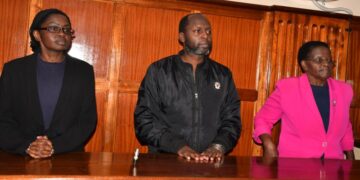

The High Court has ordered President William Ruto to reconstitute his Cabinet within 120 days after finding that its current composition violates the Constitution’s two-thirds gender principle.
In a landmark judgment delivered on Tuesday, a three-judge bench held that the Cabinet does not satisfy the constitutional requirement that no more than two-thirds of members of an appointive public body should be of the same gender.


Delivering the judgment, Justice Eric Ogola directed the President to ensure the Cabinet complies with the Constitution within the specified period.
“The appointing authority, being the President, is hereby directed to make appointments for Cabinet Secretaries in conformity with Article 27(8) within 120 days from the date of this judgment,” Justice Ogola said.
The judges found that the Cabinet is made up of 25 members comprising the President, the Deputy President, the Attorney General and Cabinet Secretaries. However, they excluded the Secretary to the Cabinet from the tally, holding that the office is not among those listed under Article 152(1) of the Constitution.
According to the court, the Cabinet currently consists of 18 men and seven women, leaving women with only about 28 per cent representation. The judges observed that in a Cabinet of 25 members, at least nine positions must be occupied by the underrepresented gender to comply with the constitutional threshold. Consequently, the bench declared that the current composition violates Articles 10 and 27 of the Constitution.
Despite that finding, the court declined to nullify the appointments of Cabinet Secretaries who were reappointed after President Ruto dissolved the Cabinet in July 2024 following nationwide anti-government protests. The petitioners had argued that bringing back some of the same Cabinet Secretaries defeated the purpose of dissolving the Cabinet, which had been presented as a response to public concerns over governance, accountability and integrity.
The judges, however, ruled that the Constitution does not bar a former Cabinet Secretary from returning to office after being dismissed.
“The text does not prescribe that dismissal under that article creates a permanent or temporary disqualification from future appointments,” the bench ruled while interpreting Article 152.
The court further drew a distinction between a general dismissal of Cabinet Secretaries and removal from office for violating the leadership and integrity provisions under Chapter Six of the Constitution, holding that only the latter may result in disqualification from holding public office.
“A general dismissal under Article 152(5)(b) is not the same thing as removal for contravention of Chapter Six,” Justice Ogola stated.
While acknowledging that reappointing ministers after dissolving the Cabinet could invite political criticism, the judges stressed that the court’s role was limited to determining constitutional compliance rather than assessing political decisions.
“The court is not called upon to determine whether the decision to return some former Cabinet Secretaries was politically persuasive or administratively wise. Rather, the court is called upon to determine whether the Constitution prohibited their nomination and appointment,” the judges held.
The bench also rejected claims challenging the appointment of opposition politicians to the broad-based government, finding that the Constitution does not prohibit such appointments provided all constitutional procedures and standards are followed.
However, the judges emphasized that political inclusivity cannot be used as a basis for overlooking constitutional obligations, particularly the requirement to uphold the two-thirds gender principle and other constitutional standards of governance and accountability.