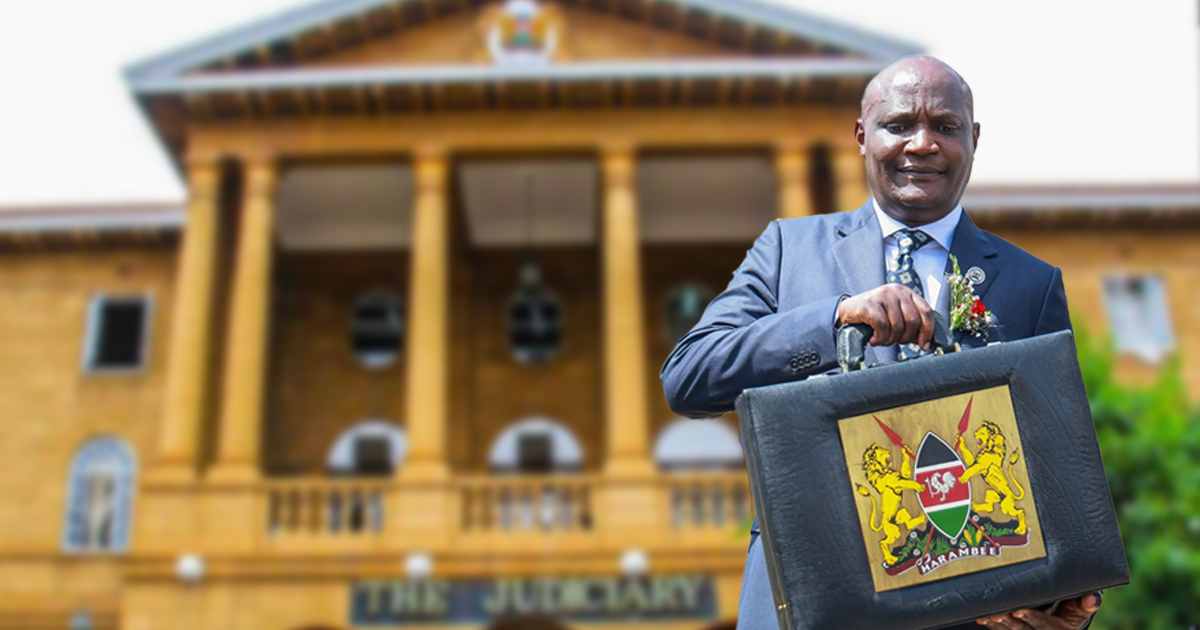
The Judiciary will receive Sh30.38 billion in the 2026/27 financial year, up from the Sh27.8 billion allocated in the previous budget, Treasury Cabinet Secretary John Mbadi announced.
Presenting the Sh4.82 trillion national budget in Parliament on Thursday, Mbadi said the allocation would support court operations and the administration of justice across the country.

“This funding will enable the administration of justice and support the continued functioning of the Judiciary,” he said.
The allocation represents an increase of Sh2.58 billion and continues a trend of rising funding for the Judiciary. In the previous financial year, its budget increased from Sh24.7 billion to Sh27.8 billion.
However, despite the increase, the allocation falls short of the Sh46 billion sought by the Judiciary for the 2026/27 financial year. The institution had requested the funds to implement programmes under the Social Transformation through Access to Justice (STAJ) blueprint and support commitments linked to the Bottom-Up Economic Transformation Agenda (BETA).
The approved allocation leaves a funding gap of Sh15.62 billion, according to budget documents.
The Judiciary’s Medium-Term Expenditure Framework for 2026/27 to 2028/29 identifies several priority areas, including expansion of e-filing services, case-tracking systems and virtual court sessions. It also plans to construct and operationalise courts in underserved areas and expand mobile court services.
Other priorities include strengthening internal audit systems, improving institutional governance, recruiting judicial officers and support staff, and implementing case management measures aimed at improving efficiency.
Separately, the Judicial Service Commission (JSC) has sought an independent allocation of Sh1.783 billion from Parliament to support its constitutional mandate. The commission is responsible for the recruitment, discipline and welfare of judicial officers. Within the justice sector, the Office of the Director of Public Prosecutions (ODPP) was allocated Sh7 billion, while the Ethics and Anti-Corruption Commission (EACC) received Sh5.1 billion.
The budget allocation comes weeks after Mbadi disclosed that the government had secured more than Sh20 billion through a World Bank financing arrangement to rehabilitate court infrastructure.
Speaking during a public engagement at Nairobi’s Jeevanjee Gardens last month, the Treasury CS said renovation works would begin at the Supreme Court before extending to other judicial facilities.
“We have done a lot for the Judiciary, by the way. We have increased their budget, and I have already negotiated with them and the World Bank to give us a lot of money, over Sh20 billion, to renovate courts,” Mbadi said.
He said some judicial facilities were in poor condition, including at the country’s highest court.
“We are starting with the Supreme Court. Our judges have no toilets; they have to look for toilets anywhere, everywhere. That is the truth. Imagine judges of the Supreme Court,” he said.
Mbadi added that the government also plans to improve facilities at the Court of Appeal and various tribunals.
“Court of Appeal, we are also working to make sure it is improved. And finally, there are tribunals which don’t even have courts, so we are going to revamp the Judiciary,” he said.
The increased budget allocation, combined with the World Bank-backed renovation programme, signals renewed focus on modernising Kenya’s justice sector. However, stakeholders continue to call for bridging the remaining funding gap to ensure full realisation of the STAJ blueprint. As case loads grow and public expectations rise, adequate resourcing remains critical for upholding the rule of law and delivering timely justice to ordinary citizens.