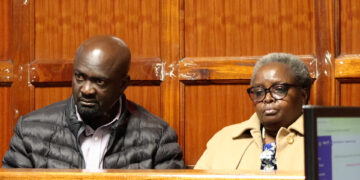
Kenya Magistrates and Judges Association (KMJA) Treasurer Hon. Kiongo Kagenyo has criticised the Judiciary’s decision to rank individual judges and magistrates based on performance data, describing the exercise as illogical and unfair due to the failure to consider the different circumstances under which judicial officers operate.
Kagenyo argues that publishing individual performance rankings using raw numerical data without considering the complexity of cases, available resources and the duration judicial officers have served in particular stations risks creating misleading conclusions about their performance.


In his remarks, Kagenyo recalled that when Chief Justice Martha Koome announced that the Judicial Service Commission (JSC) had resolved to publish individual performance outcomes for judges and judicial officers, the decision attracted mixed reactions from members of the Bench and the Bar.
While members of the public welcomed the move as an unprecedented step towards transparency and accountability, he said it also created anxiety among those who understood the dangers of presenting performance statistics without the necessary context.
According to Kagenyo, the Magistrates and Judges Associations subsequently approached the JSC and the Chief Justice seeking reconsideration of the decision, arguing that publication should have been delayed until a proper, ascertainable and verifiable method of presenting the data had been developed.
He said the associations wanted a system that would ensure performance figures were accompanied by sufficient information to enable the public to draw logical and fair conclusions. However, their proposal was unsuccessful, with the associations subsequently accused of resisting accountability.
“Nothing could be further from the truth,” Kagenyo said, maintaining that KMJA has consistently advocated for transparency, accountability and integrity within the Judiciary. He insisted that calling for an accountable process of accountability should not be misconstrued as an attempt to shield judges and magistrates from public scrutiny.
Kagenyo maintained that the association’s position was informed by the need to protect judicial independence and safeguard the quality of justice delivered to Kenyans rather than pursue selfish interests or preserve individual positions.
He further questioned the reliability of the published performance figures, arguing that the data consisted largely of raw numbers without the variables necessary to establish meaningful comparisons between judicial officers. According to him, comparing judges and magistrates solely on the number of cases concluded amounts to comparing “apples and oranges” because the nature and complexity of cases handled by different courts vary significantly.
He explained that some matters can be concluded during the first court appearance, while others require numerous hearings, several witnesses and extended proceedings before a judgment can be delivered. Other factors that influence case determination include the number of parties involved, the vulnerability and availability of witnesses, the resources available to a particular court and the length of time a judicial officer has served at a given station.
Kagenyo also pointed out that judicial officers do not enjoy equal working conditions, with some courts operating without adequate facilities, including proper courtrooms.
To illustrate the shortcomings of the ranking system, he cited situations where a judgment in a case involving a single brief witness is counted equally with a judgment in a complex matter involving 60 witnesses. He argued that while one judge could conclude several files involving one witness each, another judge handling a single case with 60 witnesses could still be conducting proceedings, yet both would be assessed using the same numerical standard.
Kagenyo also took issue with the manner in which some judges were portrayed in media reports following the publication of the Judiciary’s performance rankings.
He cited the listing of five High Court judges Justices Winnie Narasha, Joseph Were, Joseph Kipkoech, David Wanjohi Mburu and Francis Nyungu as being at the “bottom of the pile”. He argued that the description created the misleading impression that the five judges were the least performing members of the Judiciary.
According to Kagenyo, the five judges only assumed office as High Court judges in May 2026, barely a month before the end of the financial year under review. He maintained that it would therefore be unreasonable to expect them to have delivered as many judicial determinations as judges who had served throughout the entire 12-month period, particularly those who had remained in one station.
The KMJA treasurer warned that an overemphasis on the number of cases concluded could undermine the quality of judicial decisions, as judges and magistrates might feel pressured to hurriedly close files to avoid being ranked poorly or subjected to public criticism.
He cautioned that prioritising quantity at the expense of quality would strike at the heart of judicial independence.
“Sometimes, justice hurried is justice buried, just as justice delayed is justice denied,” he observed.
Kagenyo further raised constitutional concerns over the potential consequences of publishing individual performance rankings without adequate safeguards.
He cited Article 172 of the Constitution, which outlines the mandate of the Judicial Service Commission, including promoting and facilitating the independence and accountability of the Judiciary. He warned that allowing Parliament and the Executive to summon judges and judicial officers for interrogation over their performance figures, particularly as the statistics become subjects of public and political debate, could expose the Judiciary to undue interference.
According to him, the constitutional framework was not designed to allow the other arms of government to assume oversight roles that could compromise judicial independence. He argued that opening such avenues would effectively transfer part of the JSC’s constitutional responsibility to Parliament, the Executive and public opinion.
Despite his criticism of the ranking exercise, Kagenyo maintained that KMJA remains open to scrutiny, constructive criticism and transformative ideas aimed at improving service delivery within the Judiciary.
He said the association would continue advocating for transparency, accountability and integrity while pushing for adequate funding and equitable distribution of resources across all courts. Kagenyo emphasised that the Judiciary’s primary responsibility remains dispute resolution and that its performance should be assessed not merely through the number of cases concluded but also through the quality and impact of its decisions.
He called for greater investment in court facilities, proper funding and reasonable allocation of resources to enable judicial officers to discharge their responsibilities effectively. In his view, the true measure of an effective Judiciary should also include the extent to which its decisions transform society, strengthen constitutionalism and deliver lasting justice to the Kenyan people.
He argued that the robustness of constitutional interpretation, the quality of judicial precedents and the final resolution of disputes are equally important indicators of judicial independence and accountability.
Kagenyo concluded that while performance monitoring remains necessary, it must be undertaken through a fair, transparent and verifiable framework that recognises the different working conditions and demands facing judges and magistrates.
He maintained that accountability should strengthen, rather than weaken, judicial independence, warning against a system that rewards the hurried conclusion of cases at the expense of substantive justice.