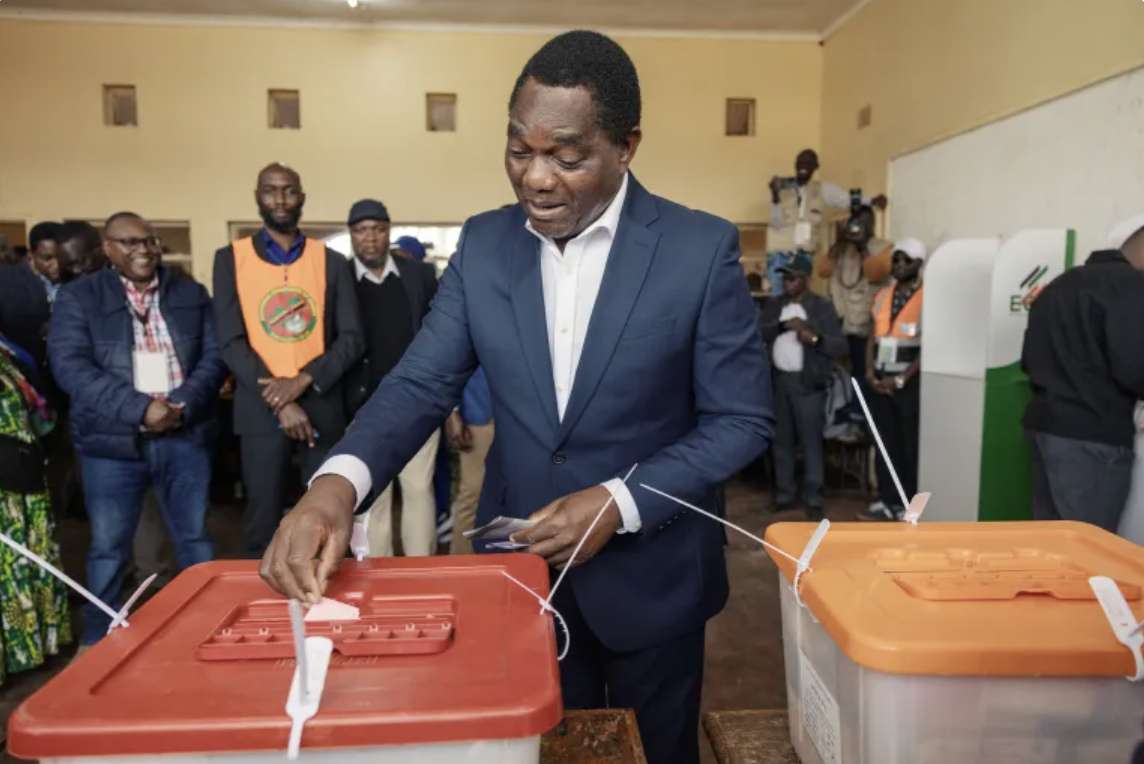
Zambian President Hakainde Hichilema has won a second five-year term after securing more than 60 percent of the vote in last week’s presidential election, according to the Electoral Commission of Zambia.
Commission chairperson Mwangala Zaloumis announced the final tally early Tuesday at the National Results Centre, declaring Hichilema of the United Party for National Development president-elect.

Hichilema received 2,965,326 votes, while his closest challenger, Brian Mundubile of the National Reconciliation Party for Unity and Prosperity, polled 1,856,217 votes. The result gave the incumbent a comfortable majority above the 50 percent threshold required to avoid a runoff.
“I therefore declare Hichilema Hakainde S to be president-elect of the Republic of Zambia this 18th day of August, 2026,” Zaloumis said.
The 64-year-old president, who first assumed office in 2021, was contesting for the presidency for the seventh time. Mundubile, 55, was making his first attempt to become Zambia’s head of state. The August 13 election, which also involved contests for Parliament and local government positions, recorded a turnout of about 57 percent from more than 8.7 million registered voters. Results from five of Zambia’s 226 constituencies were still outstanding after disruptions, but electoral officials said they could not change the presidential outcome.
Hichilema’s victory came after a tense counting period marked by reports of attacks on election officials and the theft of ballot papers. Counting was temporarily suspended on Friday as authorities dealt with the incidents. On election night, 11 people, including opposition figures, were arrested during a security operation that the government said was aimed at stopping planned militia activity. Mundubile’s party disputed the government’s account and raised concerns about the handling of results forms.
Following the declaration, Hichilema thanked voters for renewing his mandate and reached out to those who supported his opponents.
“We are truly humbled by the trust you have placed in our hands,” he said, adding that those who backed other candidates had been heard and that his administration would continue working for them.
Hichilema’s second term comes as Zambia continues to deal with the economic challenges that have dominated his first presidency. The country, Africa’s second-largest copper producer, has pursued debt restructuring, efforts to control inflation and increased investment in the mining sector.
The election was also seen as a test of Zambia’s reputation for peaceful transfers of power, with 14 candidates competing for the presidency. Hichilema’s victory gives him another five years to pursue his economic agenda while facing pressure over the cost of living, employment and the distribution of the country’s mineral wealth.