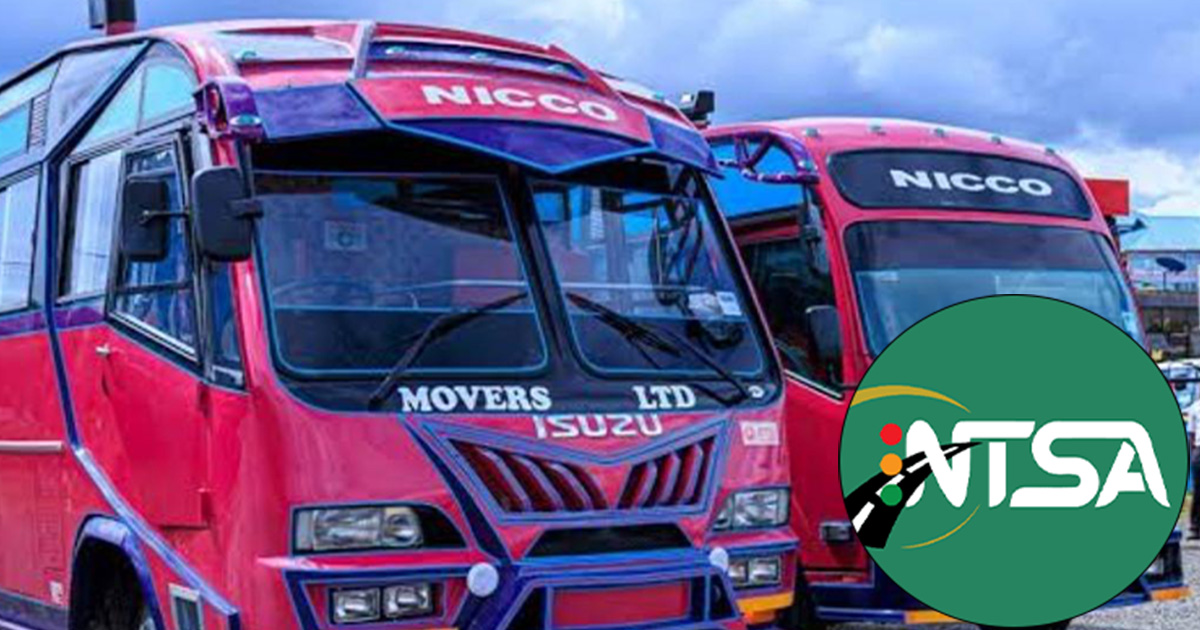
The National Transport and Safety Authority (NTSA) on Monday defended its decision to revoke the operating licence of NICCO Sacco, telling the Transport Licensing Appeals Board that the action was taken in the interest of public safety following what it described as serious and continuous breaches of transport regulations.
Addressing the Board, Lawyer Danstan Omari, appearing for NICCO Sacco argued that the revocation had effectively brought the sacco’s operations to a standstill, affecting more than 110 public service vehicles and exposing investors to significant financial losses. He told the Tribunal that many of the vehicle owners had invested heavily in the transport business and stood to lose their livelihoods if the revocation remained in force.


Omari also questioned the process leading to the revocation, citing inconsistencies in dates contained in letters issued by NTSA and arguing that the regulator had imposed the harshest possible sanction without considering less punitive alternatives.
“A revocation is finality… it’s a death sentence,” Omari submitted, warning that the decision affected over 110 investors and exposed more than 5,000 dependants to economic hardship.
Omari added that the impact extended beyond investors to the broader economy.
“The ripple effect to employment, to tax revenue to the government, and the spiral effect of crime are realities out of this decision,” he told the tribunal.
The lawyer urged the Board to issue a stay of the revocation and instead impose strict conditions that would allow NICCO sacco’s members to rectify any shortcomings identified by the regulator.
NTSA, however, opposed the application and maintained that its actions were lawful and necessary.
Through Kihamba, the Authority told the Tribunal that the revocation was not based solely on recent fatal accidents involving vehicles associated with the sacco. Instead, it stemmed from a pattern of non-compliance, including speeding violations and breaches of requirements under the Traffic Act and the Public Service Vehicle Regulations.
Kihamba submitted that the regulator had placed evidence before the Tribunal showing that numerous vehicles linked to the sacco were not compliant with the law and that public safety considerations outweighed claims of economic loss.
“Two lives are one too many,” Kihamba told the Board.
Earlier, NTSA had explained that its mandate requires it to ensure that all public transport operators comply with road safety standards and that enforcement action is only taken after efforts to secure compliance have failed.
“The underlying reason is public safety,” the Authority submitted.
Throughout the proceedings, Chairman Dr Kamotho repeatedly emphasised that the Tribunal’s primary concern was the safety of road users while at the same time seeking practical solutions where corrective action was possible. The Chairman noted that matatu saccos bring together investors with varying levels of compliance and that the Board was keen to understand whether some operators within the sacco could still be assisted to regularise their operations. At the same time, he made it clear that commercial interests could not take precedence over the safety of passengers and other road users.
“We can’t allow any operator to endanger life, irrespective of the kind of investment they will make to the sector,” Dr Kamotho said.
After hearing both sides, the tribunal directed that all affected vehicles be presented for inspection, driver and conductor details be submitted, and compliance affidavits be filed within strict timelines. Dr Kamotho further directed that, pending compliance checks and further orders of the Board, NICCO Sacco’s fleet would remain grounded.
“The respondent’s fleet of vehicles shall not resume operations in any manner whatsoever,” the tribunal ordered.
The matter will be mentioned again on Wednesday at 3 p.m. for confirmation of compliance and further directions.