
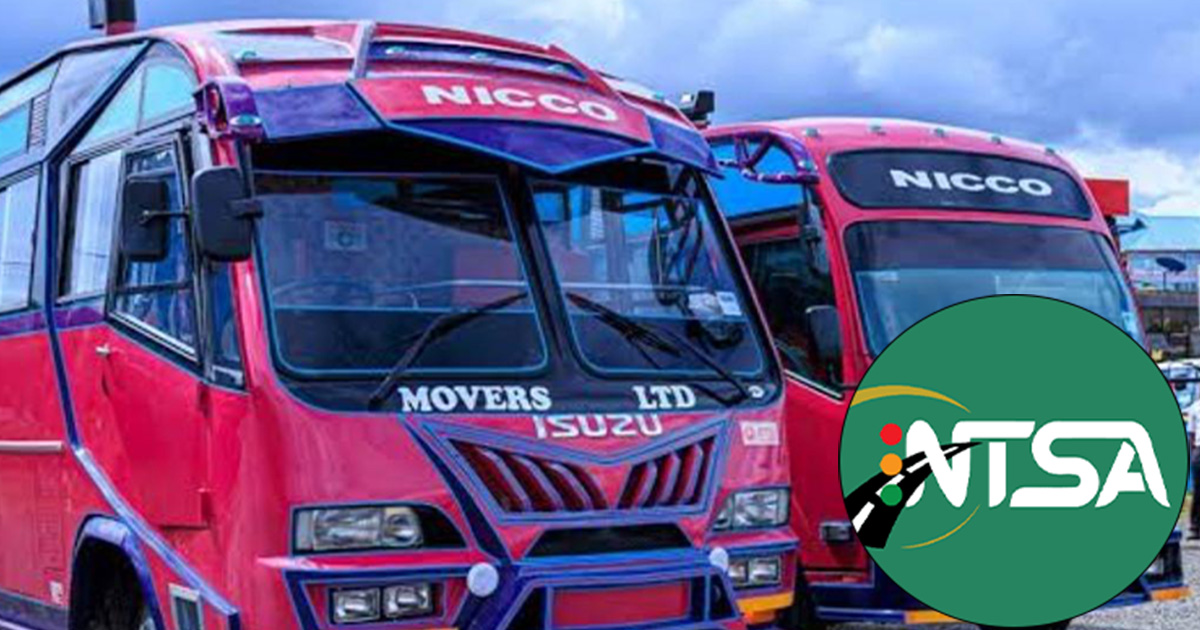
The Transport Licensing Appeals Board Tribunal has suspended the Public Service Vehicle (PSV) operator licence of Nicco Movers Limited after finding serious safety and compliance failures across its fleet, including two fatal incidents along Thika Superhighway.
The Tribunal, chaired by Dr Adrian Kamotho Njenga, however, set aside the National Transport and Safety Authority’s (NTSA) decision to revoke the operator’s licence, ruling that suspension was a more proportionate sanction under the circumstances.


The decision followed an appeal by Nicco Movers against NTSA’s revocation of its PSV operator licence after two fatal incidents involving vehicles operating under the company’s licence.
The first incident occurred on January 11, 2026, when a vehicle under the said Sacco was involved in a crash near Kenyatta University/Kahawa Sukari along Thika Superhighway, killing a pedestrian.
According to the judgment, the circumstances surrounding Eugene’s death remained contested. His mother’s case was that the conductor ejected him from the moving vehicle, while the company maintained that the passenger jumped from the vehicle.
The Tribunal noted that, according to the Interested Party’s uncontroverted account, the two abandoned the scene and had not been brought to justice.
NTSA issued a show-cause notice to Nicco Movers on June 5, 2026, citing the two fatal incidents and several fleet-wide safety violations.
The Authority said 30 vehicles had been recorded operating above the prescribed 80 kilometres per hour speed limit, while 11 vehicles were not transmitting speed-limiter data.
Another vehicle was found operating without a speed limiter, 10 had no speed-limiter records, and three vehicles had expired inspection.
The company appeared before NTSA’s Transport and Safety Committee on June 12, 2026, represented by its chief executive officer Phenius Gitau, managers, a legal officer, a risk manager and several drivers.
The Committee subsequently recommended revocation of the operator’s licence and issued 10 compliance directives, including speed-limiter onboarding onto the Intelligent Road Safety Management System, inspection of 51 vehicles, driver suspension and re-testing, blacklisting of the conductor involved in the June 5 incident, production of staff contracts and statutory records, route definition, driver sensitisation, quarterly compliance reporting and a compliance audit.
The Tribunal later ordered Nicco Movers to present 51 vehicles for inspection. The results raised further concerns. According to NTSA, only six of the 51 vehicles passed inspection, while 45 failed. The inspection certificates recorded various defects, including missing or defective passenger seat belts, missing door and window locks, faded or undersized chevrons and reflectors, defective horns and lamps, damaged body panels, and missing first-aid equipment and fire extinguishers in some vehicles.
The Tribunal found that the safety problems went beyond the two fatal accidents.
“There were two fatalities within six months on the same corridor,” the Tribunal noted, adding that 30 vehicles had been recorded travelling above the speed limit and that speed-limiter data was missing or not being transmitted across a significant part of the fleet.
The Tribunal further observed that 45 of the 51 vehicles presented for inspection failed, with many defects involving missing passenger seat belts.
It concluded that NTSA had the legal power and sufficient grounds to take regulatory action against Nicco Movers.
However, the Tribunal disagreed with the Authority’s decision to impose the ultimate sanction of licence revocation.
Under Section 34 of the NTSA Act, the Tribunal noted, NTSA has several enforcement options, including expunging specified vehicles from an operator’s licence, reducing the maximum number of vehicles, suspending the licence or revoking it.
The Tribunal held that revocation failed the proportionality test because the law provided less restrictive measures that could address the safety concerns.
“The statute therefore itself ranks the available tools: vehicle-level surgery first, suspension next, revocation last,” the Tribunal stated.
It further observed that NTSA’s own Transport and Safety Committee had already identified several corrective measures that could be implemented instead of completely cancelling the licence.
The Tribunal therefore set aside NTSA’s revocation decision and substituted it with an immediate suspension of Nicco Movers’ PSV operator licence.
The company was ordered to address the 10 safety and compliance concerns identified by NTSA. It was given seven days to address the concerns, with the Tribunal warning that if the issues remained unresolved after 14 days, NTSA could issue another notice to show cause and subsequently revoke the licence.
The Tribunal also discharged and vacated all interim orders previously issued in the case. In its judgment, the Tribunal acknowledged the loss suffered by Eugene’s family, noting that regulatory proceedings could not restore his life but could help reduce the risk of another family suffering a similar loss.
The Tribunal emphasised that the licensing dispute was not a criminal trial and made no determination on whether Eugene was unlawfully ejected from the vehicle or whether he jumped. It held that licensing proceedings and criminal proceedings serve different purposes and operate under different standards.
“Nothing in the NTSA Act or the Fair Administrative Action Act makes a pending police file a bar to licensing action,” the Tribunal ruled.