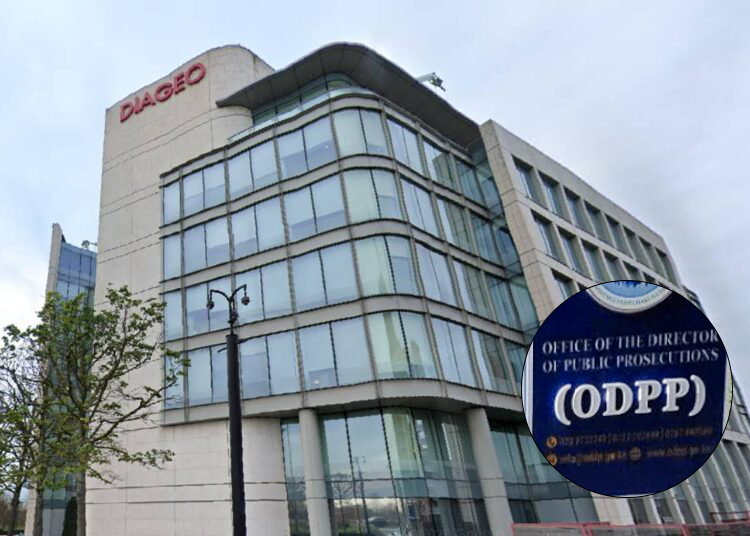
The Director of Public Prosecutions (DPP) has asked the High Court to throw out a petition filed by Diageo PLC seeking to shield itself from possible criminal investigations and prosecution arising from a commercial dispute involving Jilk Construction Company Limited and other parties.
In a preliminary objection lodged before the court, the DPP argues that Diageo moved to court prematurely because no decision has been made to charge or prosecute the company.


According to the prosecution, the petition is based on speculation and seeks to challenge criminal proceedings that have neither been initiated nor approved by the Office of the Director of Public Prosecutions. The DPP contends that the court lacks jurisdiction to entertain the matter in its current form, arguing that prosecutorial powers are exclusively vested in the DPP under Article 157 of the Constitution.
The prosecution further argues that Diageo is attempting to use constitutional litigation to interfere with lawful investigative and prosecutorial processes before they have run their course.
According to court documents, the petition violates the doctrine of constitutional avoidance because the issues raised can be adequately addressed through existing legal mechanisms under the Criminal Procedure Code and the National Police Service Act.
The DPP also maintains that the case amounts to an abuse of the court process as it seeks orders restraining the prosecution authority from exercising powers granted by the Constitution despite the absence of any demonstrated decision to prosecute.
Further, the prosecution argues that granting the orders sought would undermine the independence of the DPP’s office contrary to Article 157(10) of the Constitution, which protects the office from direction or control by any person or authority. The DPP has also challenged the petition as speculative and non-justiciable, arguing that it seeks anticipatory orders against criminal proceedings that may never materialize.
According to the objection, Diageo has failed to demonstrate any specific constitutional violation attributable to the DPP as required under established constitutional law principles.
The prosecution additionally relies on Section 193A of the Criminal Procedure Code, which provides that the existence of civil, commercial or arbitral proceedings does not prevent criminal investigations or prosecutions arising from the same facts.
The DPP argues that the petition improperly seeks to transform a commercial dispute into a constitutional question while pre-empting investigative and prosecutorial processes sanctioned by law.
The prosecution has urged the High Court to strike out the petition and dismiss the accompanying application with costs, describing both as incompetent, legally untenable and an abuse of the court process.