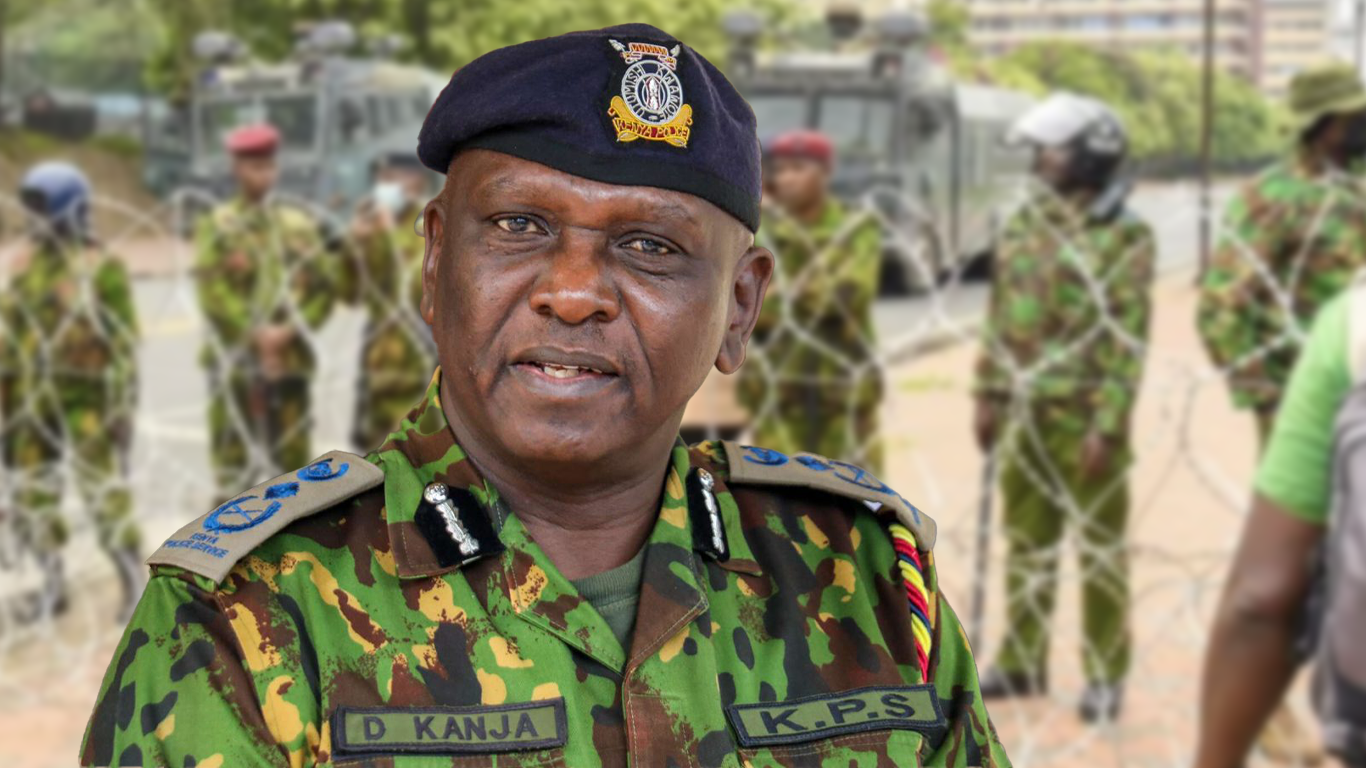
Inspector General of Police Douglas Kanja has been found guilty of contempt of court after police barricaded roads leading into Nairobi’s Central Business District without issuing prior notice to the public.
Justice Patricia Nyaundi ordered Kanja to appear before the High Court on September 28, 2026, for mitigation before the court determines the sentence to be imposed on him.

The contempt case relates to restrictions imposed by the National Police Service during commemorations connected to the June 2024 Finance Bill protests. The court had directed police to give members of the public prior notice before closing roads, erecting barricades or setting up checkpoints. The court found that police nevertheless mounted roadblocks and restricted access to the CBD on June 25, 2026, without issuing the advisory required under the order.
Justice Nyaundi dismissed the argument that the checkpoints did not amount to unlawful interference with movement, stressing that the failure to provide notice was itself a significant breach.
“Citizens cannot meaningfully exercise their movement when confronted with sudden unexplained barriers,” Justice Nyaundi said.
According to the judge, the court order placed an affirmative duty on the Inspector General to ensure that the public was notified whenever police intended to close roads or establish checkpoints.
Justice Nyaundi further held that internal police procedures could not be used to defeat or dilute a binding court order. She said Kanja could not simply distance himself from the actions of officers under his command. The court said Kanja was expected to demonstrate the steps he had personally taken to ensure compliance with the order, particularly because he was aware of the restrictions imposed by the court.
The judge also criticised the Inspector General for failing to personally respond to the allegations of non-compliance and explain what measures had been taken to ensure the order was followed. Justice Nyaundi said this was more than an administrative oversight, finding that the failure to account for compliance demonstrated a failure to appreciate the constitutional obligations attached to the office of the Inspector General.
The court connected the duty to obey the order with Articles 10 and 244 of the Constitution, which require public institutions and the National Police Service to uphold the rule of law, human rights, transparency and accountability.
Justice Nyaundi also emphasised that contempt proceedings are not about protecting the personal authority of a judicial officer, but about preserving the rule of law and ensuring that court orders are obeyed. She relied on several Kenyan and South African decisions addressing contempt of court and the importance of compliance with judicial orders. The judge further considered Article 24 of the Constitution, which requires any limitation of constitutional rights to be reasonable, justifiable and procedurally fair.
She found that indiscriminately restricting access to the CBD without providing the notice required by the court order could not be reconciled with those constitutional safeguards. The court also considered Kanja’s appearance at a press conference where assurances were reportedly given that the following day would be normal for schoolchildren, workers and business people.
Despite those assurances, roadblocks were later erected around the CBD, according to the ruling.
Justice Nyaundi ultimately found Kanja personally responsible for contempt, holding that the Inspector General had failed to ensure compliance with the July 2025 court order requiring a public advisory before roads were barricaded.
Kanja will appear before the High Court on September 28, 2026, to make submissions in mitigation. The court will then determine the appropriate sentence.