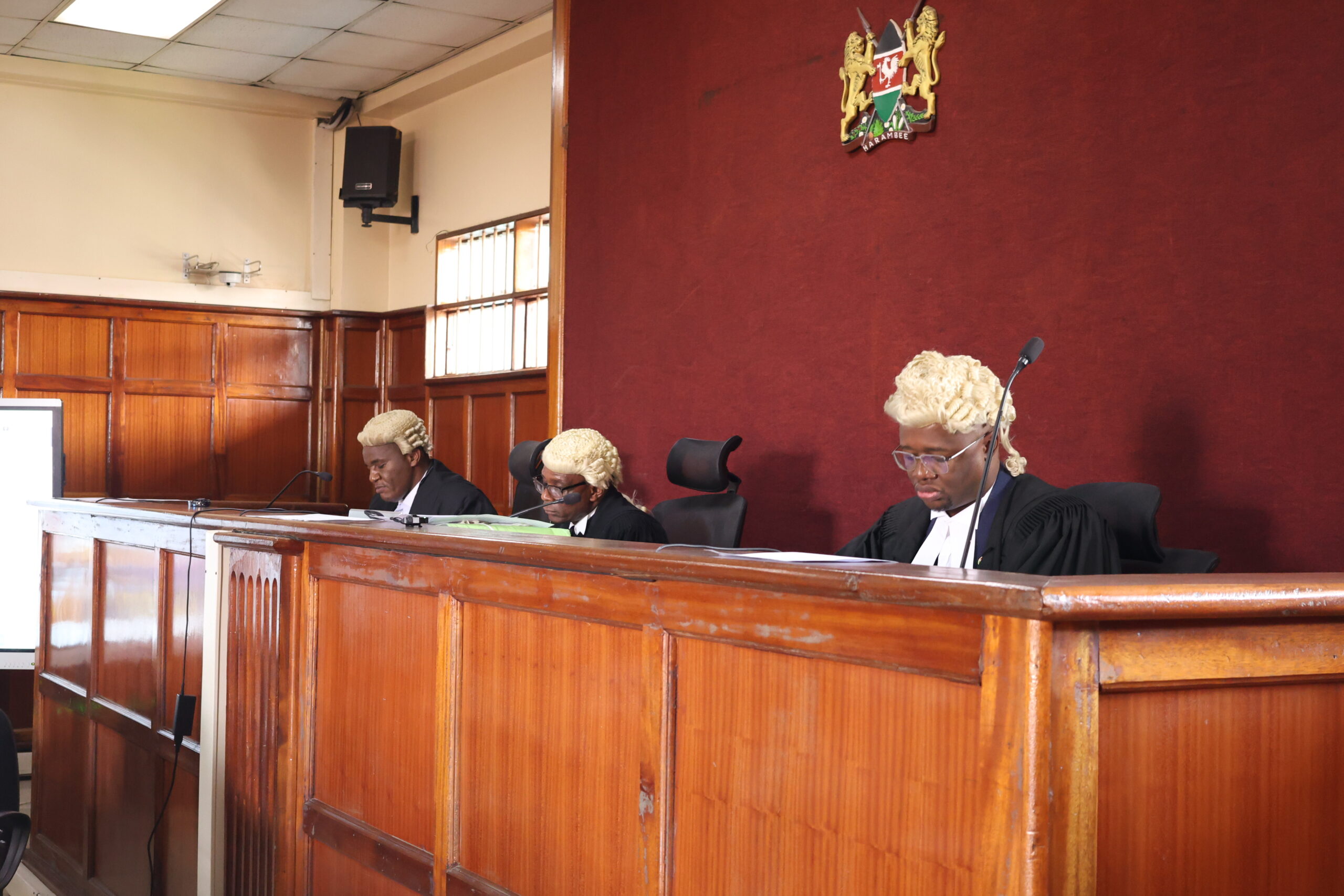
The High Court has quashed notices issued by the Judicial Service Commission (JSC) in connection with petitions seeking the removal of Supreme Court judges, declaring the process unconstitutional and barring the commission from taking further action based on the defective complaints.
A three-judge bench comprising Justices Charles Kariuki, Lawrence Mugambi and Bahati Mwamuye found that the JSC had failed to comply with constitutional and legal requirements when processing the complaints, including conducting the necessary preliminary assessment before requiring the judges to respond. The complaints included those filed by former Law Society of Kenya president Nelson Havi, Senior Counsel Ahmednasir Abdullahi and former Cabinet Secretary Raphael Tuju, among others.


The court ruled that the notices and directions were issued without proof of a lawfully convened meeting of the commission and that the process failed to safeguard the petitioners’ right to fair administrative action under Article 47 of the Constitution. “A declaration is hereby issued that the first respondent in issuing the affirmative communication notices and directions failed to undertake the requisite preliminary threshold assessment necessary to safeguard the petitioner’s right to fair administrative action under Article 47 of the Article 47 of the Constitution,” the bench said.
The judges also faulted the JSC for handling the complaints against the judges collectively rather than setting out the specific grounds against each of them. “A declaration is hereby issued that the collective, composite or omnibus manner in which the first respondent proceeded against the petitioners was contrary to the Constitution and the law,” the judges noted.
The court further found that the commission had failed to specify the grounds and particulars required under Article 168 of the Constitution, which provides the framework for the removal of judges. “A declaration is hereby issued that the first respondent failed to set out the grounds and the particulars contemplated under Article 168(1)(a)-(2)(b) of the Constitution,” the judges said.
Consequently, the court declared the communications, notices and directions relating to JSC Petition Nos. 72 of 2024, 3 of 2025 and 35 of 2024 unconstitutional, legally defective, null and void.
The bench issued an order of certiorari quashing the notices dated January 27, 2025, together with correspondence, actions and proceedings arising from the three complaints. It also prohibited the commission from taking further steps, commencing or continuing proceedings, or making decisions based on the defective notices. “An order of prohibition is hereby issued prohibiting the first respondent, whether by itself, its agent, servant, or any other person… from taking any further steps, commencing or continuing any proceedings, or making any decisions based upon or arising from the defective notices already issued,” the court ruled.
The complaints were filed under Article 168 of the Constitution, which outlines the grounds and procedure for removing a judge. The affected judges challenged the commission’s handling of the complaints, arguing that the process threatened judicial independence and could be used to review Supreme Court decisions through disciplinary proceedings.
The seven judges had filed separate petitions challenging the JSC’s decision of January 27, 2025, which were later consolidated. The court directed each party to bear its own costs, citing the public interest involved in the case. “This being a matter of great public interest, which transcends the personal claims of the parties, each party shall bear its own costs,” the court ruled.