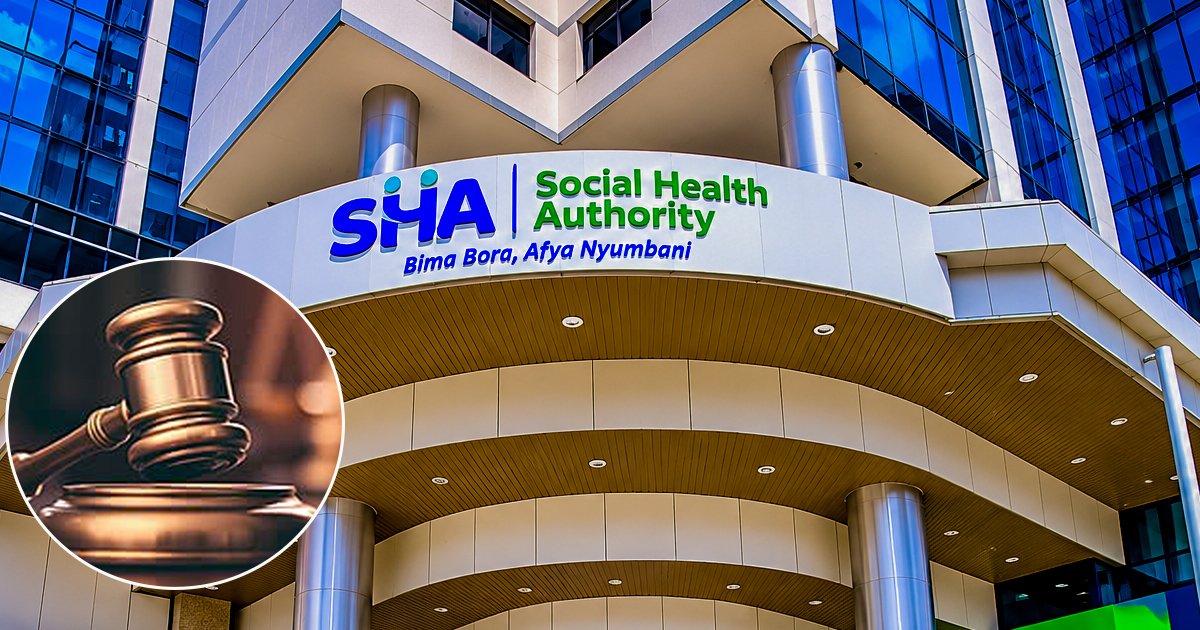
The High Court has declared the 2% Health Information Management Service (HIMS) fee deducted from Social Health Authority (SHA) payments to healthcare facilities unconstitutional, ruling that the government failed to conduct adequate public participation before introducing the controversial charge.
Justice R. Nyakundi, sitting at the High Court in Vihiga, directed the government to review the fee and bring it into compliance with the Constitution within 120 days.


The judgment was delivered on Tuesday, November 24, 2026, following a petition filed by Dr Magare Gikenyi, Eliud Karanja Matindi and Okiya Omtatah Okoiti against SHA and other government agencies. The petition challenged the legality of the 2% deduction imposed on payments made to healthcare facilities for medical services provided to patients under the Social Health Insurance scheme.
Under the arrangement, 2% of every approved claim, capped at Sh.5,000, is deducted as a HIMS system utilisation fee and remitted to the Digital Health Agency (DHA), leaving healthcare facilities with the remaining 98%.
The petitioners argued that the deduction amounted to unconstitutional taxation and double charging, questioning why healthcare facilities should pay to use a digital health system whose development and acquisition they claimed had already cost taxpayers approximately Sh.104 billion. They also questioned the involvement of private company Finsprint Limited in the payment arrangement, raising concerns over the handling of public funds and patients’ confidential medical information.
However, the government defended the charge, arguing that it was a lawful service fee authorised under the Digital Health Act, 2023, and was necessary to maintain the country’s digital health infrastructure.
In his determination, Justice Nyakundi found that the government had failed to demonstrate that the public was specifically consulted on the 2% fee, its calculation formula and the basis for arriving at the amount.
“The fee was never put to the public as a fee, with its amount and its formula, before it was made,” the judge held.
He added that consultation on the regulations generally was insufficient when the government intended to introduce a specific financial charge affecting healthcare providers. “That failure is fatal to the fee in its present form,” Justice Nyakundi ruled.
The judge, however, distinguished between an unconstitutional tax and a legitimate service charge, finding that the HIMS fee had a statutory foundation under Section 48(1)(c) of the Digital Health Act, which allows the Digital Health Agency to collect fees for services rendered.
He noted that healthcare facilities paid the charge in return for electronic submission, validation, tracking and payment of claims through the national digital infrastructure. Nevertheless, the court questioned how the government arrived at the 2% figure, noting that no financial evidence had been presented to demonstrate the actual cost of operating the electronic claims system.
“The silence of the record on cost is not a matter of indifference,” the judge observed.
He further warned that a government agency imposing a charge based on the value of transactions must demonstrate how the amount relates to the cost of providing the service.
On whether the fee amounted to a tax, the judge declined to make a definitive finding, saying the petitioners had not discharged the burden of proving that allegation. The court also found that the government had violated the petitioners’ right to access information under Article 35 of the Constitution by failing to provide information requested concerning the financial and legal arrangements surrounding the fee.
Justice Nyakundi consequently directed the Attorney General to provide leadership in ensuring the disputed charge is reviewed and, if retained, reintroduced in accordance with the Constitution within 120 days. The process must involve meaningful public participation and a Regulatory Impact Statement explaining the basis on which the fee is calculated.
The judge declined to order a refund of money already deducted from healthcare facilities, arguing that the collections had been made under a published legal instrument that was presumed valid at the time. “A refund of fees on hundreds of thousands of claims would be disproportionate to a procedural defect,” he ruled.
The court also dismissed an application by the petitioners seeking to bar Kilukumi & Co. Advocates from representing the Cabinet Secretary for Health and the Principal Secretary for Medical Services.
The judge found that the challenge to the law firm’s appointment was not founded on transparency or merit-based criteria. He further directed state agencies to submit monthly progress reports on implementation of the judgment to the Deputy Registrar of the High Court.
The court ordered each party to bear its own costs, describing the matter as public interest litigation