The High Court on Friday heard sharp accusations that the Law Society of Kenya (LSK) was applying double standards by urging advocates to boycott selected judges while at the same time turning to the courts to defend itself against a constitutional challenge to the directive.
Appearing before Justice David Mburu, lawyers representing the petitioner and several interested parties questioned why the Society had instructed external counsel to represent it in court while advocates who continued appearing before judges on the boycott list allegedly faced threats of disciplinary action.


The constitutional petition, filed by lawyer Dr Adrian Kamotho, seeks conservatory orders suspending resolutions adopted by the LSK Council directing advocates to boycott proceedings before several judges and magistrates. Kamotho argues that the boycott undermines judicial independence, violates advocates’ constitutional rights and threatens access to justice. The suit names the Law Society of Kenya as the respondent, with the Judicial Service Commission (JSC), Chief Justice Martha Koome, Deputy Chief Justice Philomena Mwilu, several judges, Chief Magistrate Stella Atambo and the Kenya Magistrates and Judges Association among the interested parties.
Kamotho urged the court to immediately issue conservatory orders, arguing that the respondent had been served but had failed to file a response, leaving advocates exposed to uncertainty and possible disciplinary action.
The Law Society, through its lawyers, opposed the application and sought more time to respond, saying it had only recently been served and required adequate time to prepare responses to the petition and the application. It also argued that no evidence had been presented to show that court operations had been disrupted or that there was any prejudice warranting urgent intervention.
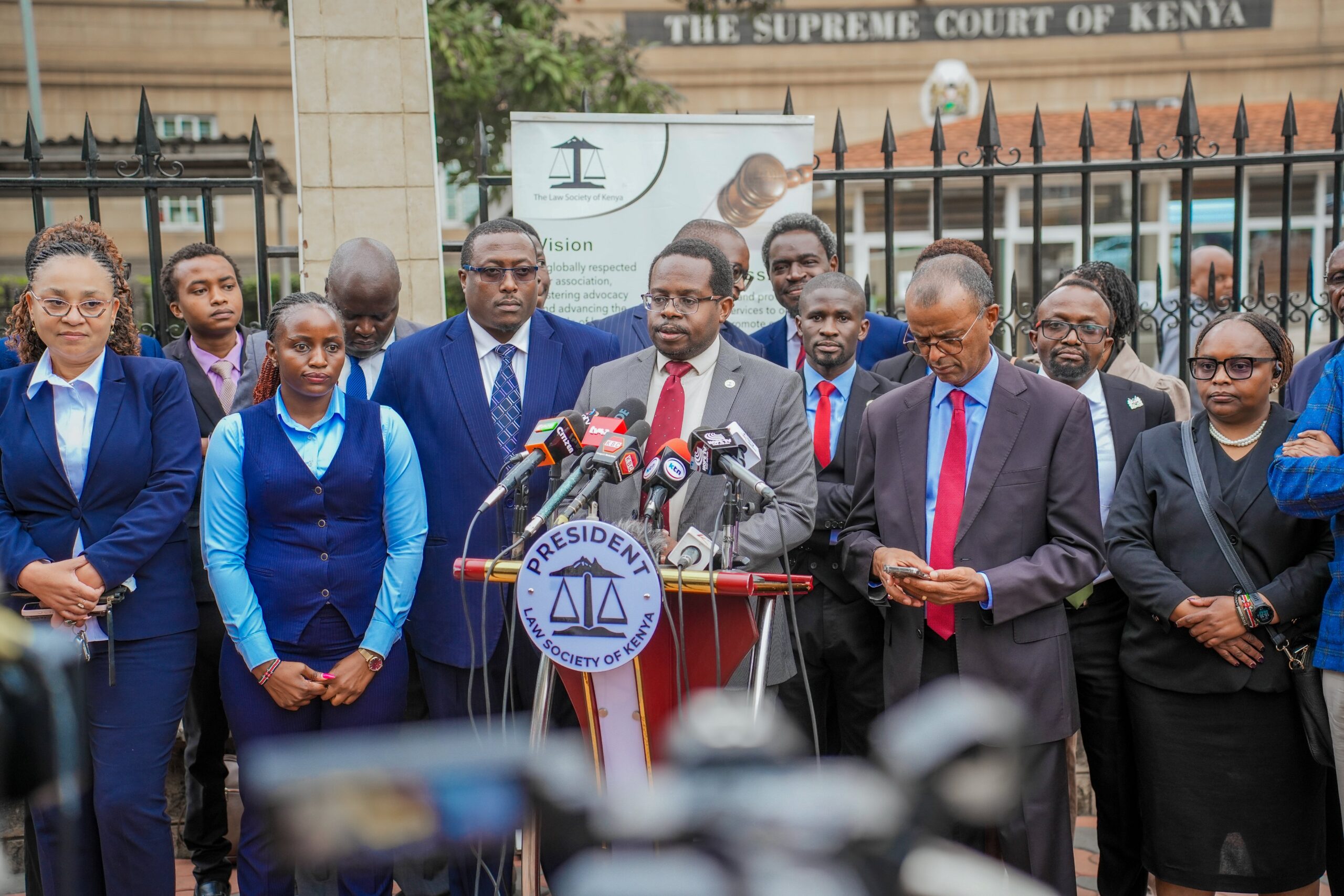
The proceedings briefly took a procedural turn after Justice Mburu questioned why lawyers appearing for the Society had addressed the court before formally filing a Notice of Appointment. The court stood the matter down to allow the respondent to regularise its representation before proceedings resumed. The Society subsequently came on record through Muma & Kanjama Advocates, led by Senior Counsel Charles Kanjama, who by himself called for the boycott.
Counsel Danstan Omari, appearing alongside advocate Shadrack Wambui for the 9th and 13th interested parties, questioned what he described as the contradiction in the Society’s conduct.
“The Law Society president called the strike. He stormed into court himself. He has now appointed senior counsel to represent himself,” Omari submitted.
He argued that while ordinary advocates were allegedly being warned against appearing before judges on the boycott list, the Society had no difficulty seeking relief from the same courts.
“As Kamotho says, allowances are going to the law firm of the president. Advocates who are poor, like me, are likely not to have any fees,” he added.
Omari further told the court that the boycott had already begun disrupting judicial proceedings in several courts, including matters before the High Court, magistrates’ courts and the Supreme Court, warning that the Society had exceeded its statutory mandate.
“The Law Society of Kenya has gone rogue,” Omari submitted. “The citizens of this country are the consumers of justice, not the advocates. The Judiciary exists for the benefit of 55 million Kenyans,” he added
He argued that the LSK, being a statutory professional body, had no legal authority to call what effectively amounted to an industrial strike capable of paralysing court operations.
“The Law Society of Kenya is a professional body, not a trade union,” he submitted.
Kamotho also opposed the respondent’s request for more time, accusing it of delaying the proceedings after already benefiting from the court’s indulgence earlier in the day.
He told the court that advocates who continued appearing before the affected judicial officers were living under constant uncertainty because of the Society’s threats of disciplinary action.
“We don’t even know what will happen to us after today’s session,” Kamotho said.
Counsel for the Law Society, Wycliffe Oyoo, defended the request for more time, insisting the respondent was entitled to file its response before the court considered any interim orders.
He dismissed Kamotho’s criticism with a political jab, saying, “I’m not sure Mr Kamotho can blame me for him not winning LSK elections.”
Justice Mburu eventually brought the exchanges to an end, declining to determine the application for conservatory orders on Friday. Instead, he directed the Law Society to file and serve its response before the matter returns on Monday, August 3, for further directions.
In explaining the adjournment, the judge noted that he had been informed of a scheduled meeting between the Law Society and the Judicial Service Commission, observing that the discussions could potentially influence the dispute. He also noted that with courts not sitting over the weekend, there was no immediate threat requiring the court to intervene before Monday.
The petition is expected to test the legality of the LSK boycott and determine whether the Society can lawfully direct advocates to avoid appearing before specific judicial officers while pursuing its own interests before the courts.