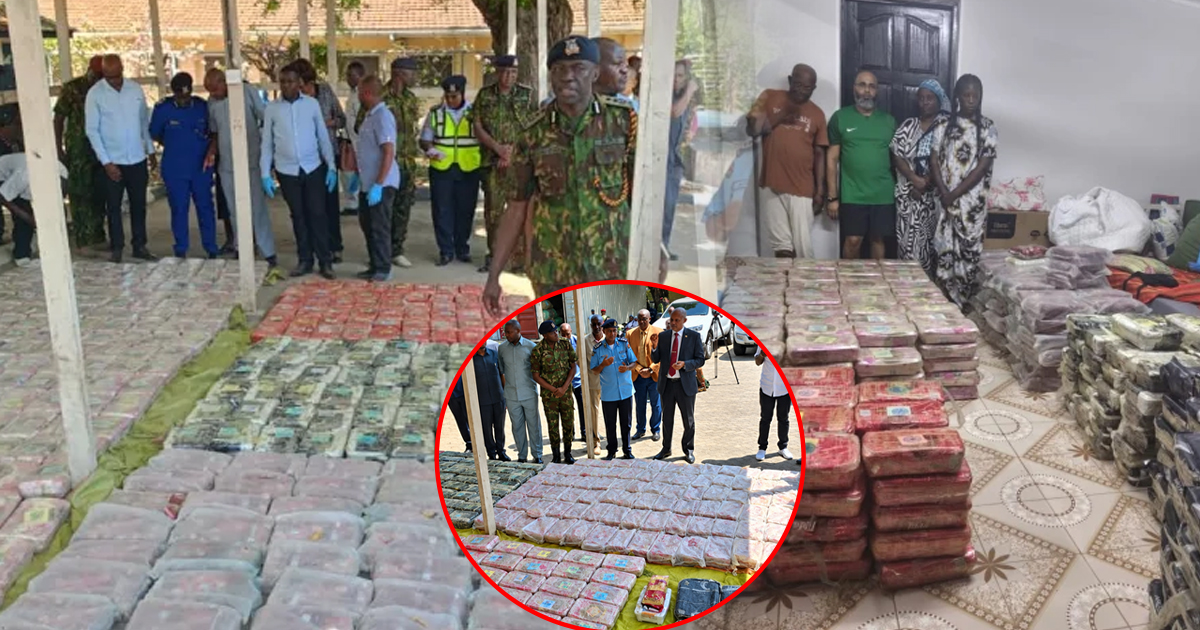
The Directorate of Criminal Investigations (DCI) has ruled out any connection between the 454 kilogrammes of suspected methamphetamine seized in Kwale County and the 1,036 kilogrammes recovered aboard MV Mashala in the Indian Ocean last year.
DCI Director Mohamed Amin said preliminary investigations had established that the two drug consignments originated from different countries and were being handled by separate trafficking networks. According to Amin, the drugs recovered in Kwale were traced to Pakistan, while the consignment intercepted aboard MV Mashala originated from Iran. He added that detectives had identified differences in the packaging, labelling and nationalities of individuals linked to the two operations.

Speaking at the Coast Regional Police Headquarters, Amin disclosed that the latest seizure resulted from a multi-agency investigation involving Kenyan, Tanzanian and other international security agencies. Investigators believe the drugs were intended for distribution in several countries across Eastern and Southern Africa.
“These drugs were destined for some Eastern African and South African countries,” Amin said.
He cautioned that investigations were ongoing, with detectives pursuing additional leads to uncover the wider trafficking network, including its financiers, organisers and other individuals involved.
The recovery followed an intelligence-driven security operation conducted on November 7, 2026, which resulted in the arrest of three suspects in Kwale County. Among those arrested was Basleman Saleh Khamis, whom investigators described as a notorious suspected drug trafficker wanted in Kenya and Tanzania. The operation also led to the arrest of 37-year-old Ugandan national Nakabugo Zuraicah.
The two were apprehended in Shirazi village by a multi-agency team led by anti-narcotics detectives. Acting on further intelligence, officers proceeded to Ganja La Simba in Kinondo, where they conducted a targeted search and recovered 454 kilogrammes of suspected methamphetamine. A third suspect, identified as 54-year-old Tanzanian national Hamad Seif Said, was arrested at the location.
The seized narcotics have an estimated street value of Sh3.6 billion.
Police also recovered two vehicles, a white Ford station wagon and a white Ford pickup, as well as a red TVS motorcycle believed to be connected to the suspected trafficking operation. The three suspects remain in police custody as investigations continue.
Amin attributed the breakthrough to intelligence cooperation between Kenyan and Tanzanian authorities, noting that collaboration across borders was essential in dismantling organised criminal networks. Detectives are now working to establish the routes used to transport the drugs into the country, their intended destinations and the individuals financing the trade.
The latest seizure comes weeks after authorities destroyed 1,036 kilogrammes of methamphetamine intercepted aboard MV Mashala in the Indian Ocean. The consignment, estimated to be worth Sh8.2 billion, was destroyed on September 24, 2026, at Bamburi Cement Factory in Mombasa under the supervision of Interior Cabinet Secretary Kipchumba Murkomen.
The exercise was attended by representatives from the Judiciary, Office of the Director of Public Prosecutions, Government Chemist, security agencies and the Kenya Navy.
Amin described the operation as evidence of Kenya’s increasing ability to disrupt maritime narcotics trafficking. He further revealed that the National Police Service had recovered narcotics valued at approximately Sh779.6 million between January 1 and October 31, 2026. The seizures comprised 21,005.4 kilogrammes of cannabis sativa valued at Sh630.1 million, 10.23 kilogrammes of cocaine worth approximately Sh40 million, 7.74 kilogrammes of heroin valued at Sh23.2 million and 7.67 kilogrammes of methamphetamine estimated at Sh61.3 million.
During the same period, police arrested 1,631 people suspected of involvement in narcotics-related offences.
The DCI director said the government’s anti-drug strategy was expanding beyond intercepting consignments and arresting couriers to dismantling the financial networks that sustain the illegal trade. He noted that the National Police Service was working alongside the Asset Recovery Agency to identify and seize property suspected to have been acquired using proceeds from drug trafficking.
The targeted assets include money, motor vehicles, residential properties and businesses associated with suspected traffickers.
“We want to reach the financiers, the organisers and the beneficiaries behind these criminal enterprises,” Amin said.
He also attributed the strengthened investigative capacity to the transformation of the former Anti-Narcotics Unit into the National Anti-Narcotics Investigation Bureau.
As part of the restructuring, 208 officers from the Kenya Police Service and Administration Police Service were recruited into the bureau in April 2026. The bureau has additionally established 40 new stations across the country, while 314 officers have received specialised basic training in narcotics investigations at the National Criminal Investigations Academy in Nairobi.
Amin said the government would continue strengthening intelligence-sharing arrangements with international law enforcement agencies to prevent Kenya from becoming a transit point or destination for illegal drugs.
He warned international trafficking syndicates that investigators would pursue all individuals involved in the trade, from suppliers and couriers to financiers and beneficiaries.
“Kenya is not a transit route. Kenya is not a market. And Kenya will not be a haven for drug traffickers,” he said.