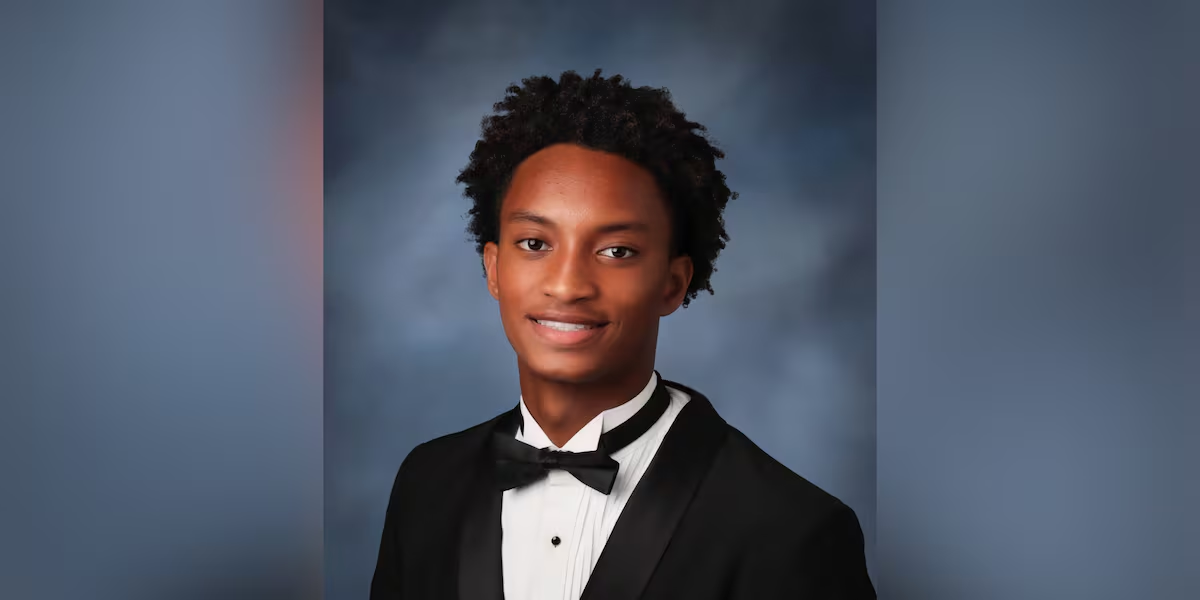
A Mississippi grand jury has declined to bring criminal charges over the death of 18-year-old Nolan Wells, whose body was recovered from waters near Horn Island after a Fourth of July outing.
The Jackson County District Attorney’s Office released the grand jury’s findings on Monday following an investigation that examined witness accounts, physical and electronic evidence, as well as cellphone and GPS data.


The panel concluded that there was no evidence of criminal conduct or a racially motivated crime in connection with Wells’ death. According to the report, the location and condition of Wells’ body, together with the time it was discovered, were consistent with death by drowning.
Wells, who was Black, had been on the remote barrier island with a group of friends, several of whom were White. His death generated widespread public speculation after photographs from the trip circulated online. Jackson County District Attorney Angel Myers McIlrath said investigators found no evidence supporting claims that Wells’ disappearance or death was racially motivated.
“There is absolutely no evidence to support the allegations that Nolan’s death and disappearance were racially motivated,” McIlrath said in a video statement released with the grand jury report. However, civil rights lawyer Ben Crump, who represents Wells’ family, questioned the decision and said important issues surrounding the teenager’s death remained unresolved.
Crump pointed to bruising found on Wells’ body, including an injury to the back of his head. The grand jury acknowledged the bruising but determined that it was not fatal. It also said the precise cause of the injury could not be established.
The panel reported that no fatal injury or underlying disease had been identified during the examination of Wells’ body. Wells was found in the water near Horn Island on July 6. Jackson County Coroner Bruce Lynd previously said there were no obvious signs of trauma or foul play when the body was recovered. Because of the circumstances surrounding the death, Lynd’s office requested a full examination by the state medical examiner to establish the cause and manner of death.
The state autopsy was conducted on July 7, while a second examination commissioned by Wells’ family and carried out outside Mississippi took place three days later. The family-commissioned examination initially classified the manner of death as undetermined pending additional investigation.
Wells’ family has continued to seek the release of information from the investigation. Crump has called on the district attorney’s office to make the state medical examiner’s complete autopsy report public and maintain the investigation.
The case had attracted heightened attention partly because of Mississippi’s history of racial violence and the circumstances surrounding Wells’ final hours.
Three of Wells’ friends—Warren Hudson, Jax Pitalo and Morgan Seymour—said through their lawyers that they had travelled to Horn Island as part of a larger group of about 30 people. They said Wells remained on the island when the others left. The three men have denied having any involvement in Wells’ disappearance or death.
McIlrath said the investigation found no evidence contradicting the account that Wells had chosen to remain on the island.
Lawyer Edward Paltzik, who represents the three friends, welcomed the grand jury’s findings and maintained that his clients had never been involved in Wells’ death. Paltzik and fellow attorney Tyler Cox later said the men and their families were relieved by the outcome and were considering their next steps.
The grand jury nevertheless left open the possibility of further action if new evidence emerges. It stated that evidence suggesting Wells’ death was not accidental could be presented for consideration in the future.
Mississippi has no statute of limitations for homicide, meaning authorities could revisit the case if evidence pointing to a criminal death is subsequently uncovered.