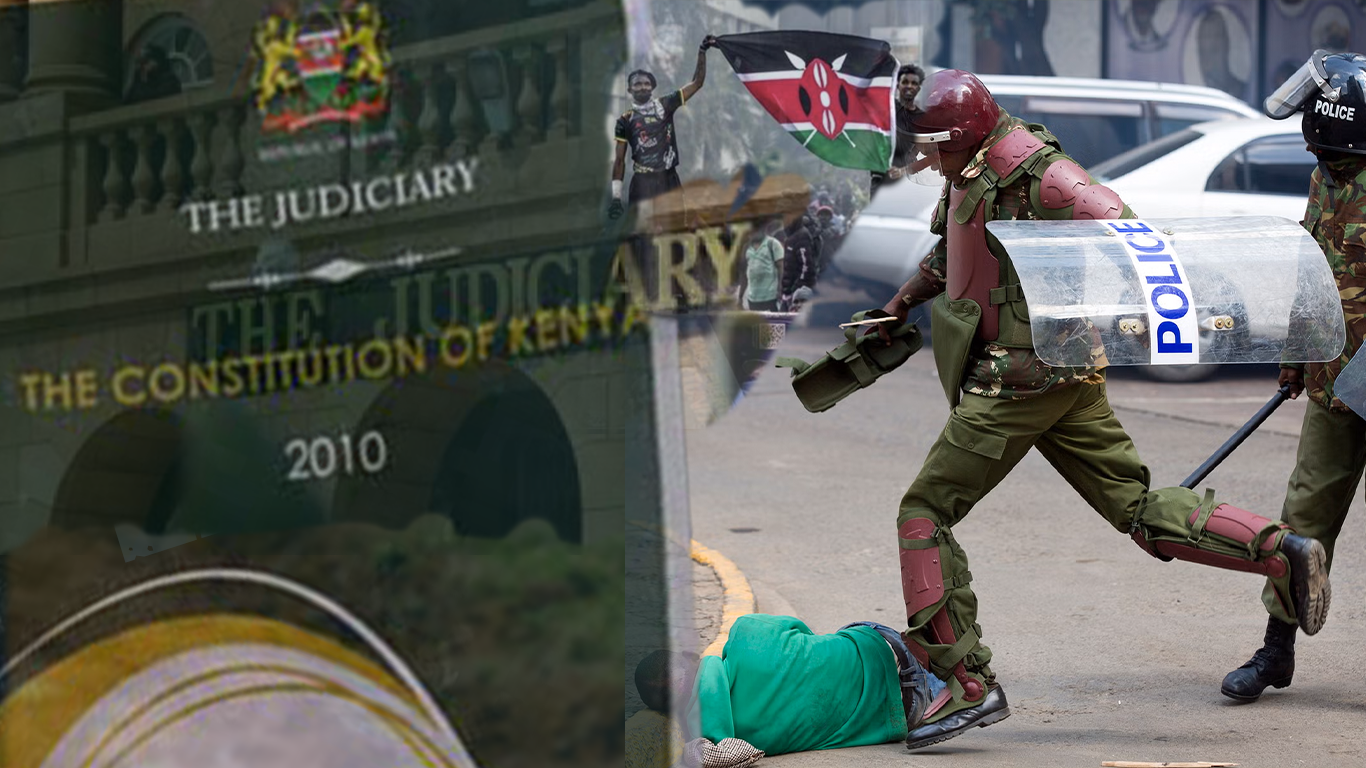
A video of content creator Abel Mutua describing Kenya’s Constitution as “tissue paper” has been making rounds on social media, reopening a debate that has followed the country since the promulgation of the 2010 Constitution: what happens when a country has strong laws but those laws are not fully obeyed?
Mutua’s remarks may have sounded harsh, but they have struck a nerve because many Kenyans have experienced the gap between what the Constitution promises and what happens when those promises are tested. Veteran human rights lawyer Dr John Khaminwa has also expressed frustration over the continued violation of the Constitution. “Tumechoka, tumechoka, Your Honor, tumechoka. Things are happening in this country that are actually violating the Constitution, which is the best Constitution in Black Africa,” Khaminwa said in one of the Milimani courtrooms while defending youths arrested during maandamano.
His remarks capture the contradiction at the heart of Kenya’s constitutional story. The country has a Constitution that provides extensive protection for individual rights, limits State power and gives courts authority to intervene when those rights are violated.
Former Chief Justice David Maraga has made a similar argument, but with a different emphasis. “We have one of the best Constitutions in the world. Shida ni kutekeleza,” former CJ Maraga said, pointing to implementation as the bigger problem. That distinction matters.
The 2010 Constitution is not a weak document. It is the foundation of Kenya’s system of governance, protection of rights and administration of justice. Chapter Four contains an extensive Bill of Rights. Article 26 protects the right to life, Article 29 protects people from arbitrary deprivation of freedom, Article 37 guarantees the right to peaceful assembly, demonstration and picketing, while Article 49 sets out the rights of arrested persons. Article 23 gives the High Court power to grant remedies when fundamental rights are violated.
The tools are there. The question is whether they are being used as intended.
The events of June 25, 2026, provide one of the clearest examples. A High Court order issued in July 2025 barred police from blocking roads in Nairobi without giving the public notice. The order was later extended. Yet, on June 25, 2026, as Kenya marked the second anniversary of the 2024 protests, police blocked several major routes into Nairobi, including Thika Road, Waiyaki Way and Mombasa Road.
The matter eventually returned to court.
On September 17, 2026, Justice Patricia Nyaundi found Inspector-General of Police Douglas Kanja personally in contempt over the failure to comply with the court order. He was directed to return to court on September 28 for mitigation and sentencing.
The sequence is telling.
A court issued an order. The order was not fully complied with. The matter returned to court, and the head of the National Police Service was found personally in contempt. The Constitution had provided the remedy. The court had issued the order. The difficulty was ensuring that it was obeyed.
The same protests also raised another constitutional question: what happens to people who are arrested but cannot be traced?
The Kenya National Commission on Human Rights reported cases of people who were arrested during the June 25 demonstrations and later became difficult to locate. Six people, including Boniface Mulinge Muteti, Elisha Ochieng Alam, Collins Otieno, Fredrick Ojiro, Christine Alubengo and Michael Ngige, were reported to have been arrested outside Parliament and placed in a police vehicle before their whereabouts became unclear.
Their families and rights groups sought answers, while police denied holding them. The men were later reportedly found after being released and, according to rights groups, some were again taken by armed men in civilian clothes. Such cases raise the very questions Articles 29 and 49 were designed to answer.
The courts have also dealt directly with the conduct of police officers during demonstrations. In 2025, the High Court issued orders requiring police officers deployed during demonstrations and other public assemblies to remain identifiable and wear uniforms. The court also addressed the use of unmarked vehicles. Yet rights groups reported the presence of masked and plain-clothes officers during the June 25, 2026 protests.
Again, the issue was not the absence of a legal framework. There was already a court order. The issue was compliance.
The same concern can be seen in continued reports of enforced disappearances and police killings. Amnesty International Kenya has reported 19 enforced disappearances in 2026, alongside figures from the Missing Voices Coalition documenting dozens of police killings. These are reports by rights organisations and do not mean that every reported case has been judicially established as an enforced disappearance or unlawful killing by the State.
For families affected by such events, the Constitution is not an academic document. It is supposed to determine what the police can do, what the State cannot do and what remedy is available when those limits are crossed.
That is why the “tissue paper” description is so provocative. If the Constitution were simply a collection of words with no legal force, the courts would have little power to stop government action. But that is not the Kenya created by the 2010 Constitution.
Kenyan courts have struck down government decisions, ordered the release or production of detained persons, awarded compensation for rights violations and held public officials personally responsible for disobeying court orders. Those cases demonstrate that the Constitution can work. What weakens public confidence is what happens after the judgment.
Kenya does not need to pretend that its Constitution is perfect. No constitutional document is. But if it is followed faithfully, it should not be reduced to the “tissue paper” label. Its protection should be felt where it matters most, in the police station, in the courtroom, in the street and in the lives of ordinary Kenyans.