
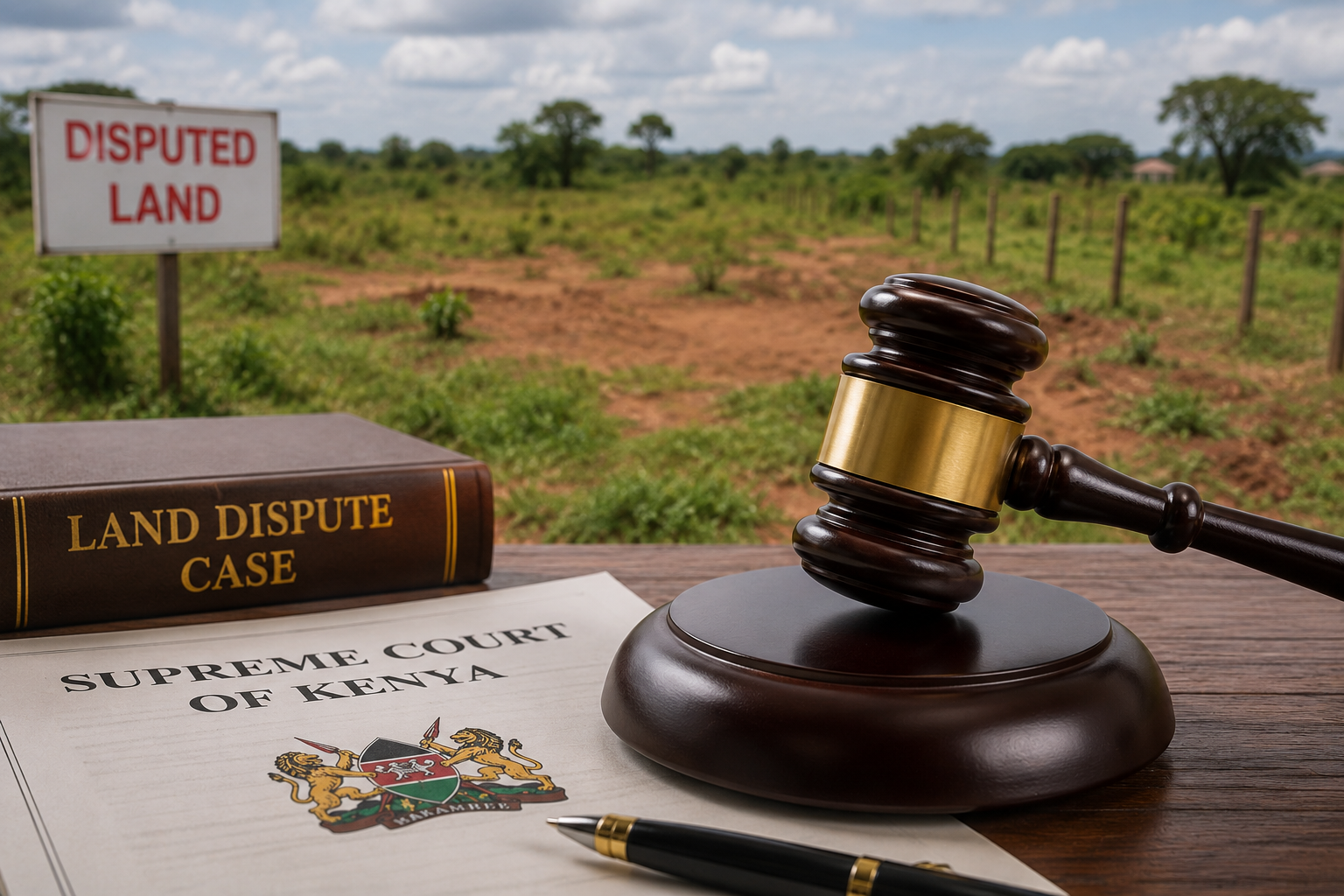
The Supreme Court has rejected an attempt to reopen a protracted land dispute involving several parcels in Mombasa, holding that the applicant failed to provide a satisfactory explanation for waiting more than six years before seeking to appeal.
A five-judge bench comprising Chief Justice Martha Koome, Deputy Chief Justice Philomena Mwilu, and Justices Smokin Wanjala, Isaac Lenaola, and William Ouko dismissed an application by the estate of the late Abdalla Mohamed Abdalla seeking leave to file a Notice of Appeal and appeal out of time.


The dispute concerns parcels known as Mombasa/Block XVI/583, 598, 606, 607, 608, and 609. Abdalla had accused the County Government of Mombasa of unlawfully entering the property, demolishing structures, and constructing a road across the land without compensation or due process.
In 2018, the Environment and Land Court ruled that although the county’s actions amounted to trespass, the affected area had historically been used as a public access road. The court further found that no compensable developments existed on the land before the road works commenced. That decision was upheld by the Court of Appeal on March 7, 2019, effectively denying the claimant compensation and restoration of the property.
Following Abdalla’s death in January 2021, his estate, represented by Saniya Abdalla Mohamed, sought to challenge the appellate court’s decision before the Supreme Court. The application, however, was not filed until January 2026. The estate argued that the deceased had been suffering from a terminal illness when the Court of Appeal delivered its judgment and was therefore unable to give instructions regarding a further appeal. It was also submitted that the administrator of the estate had pursued negotiations and other legal avenues before eventually seeking relief from the apex court.
The applicant further cited a demand by SBM Bank Kenya Limited, which had threatened to auction the property over an outstanding loan of KSh55 million. According to the estate, the road construction significantly diminished the property’s value and commercial viability.
The County Government of Mombasa opposed the application, describing the delay as excessive and unjustifiable. The county maintained that the deceased was represented by legal counsel throughout the proceedings and that no evidence had been presented to demonstrate mental incapacity preventing him from pursuing an appeal. It also argued that after obtaining the grant of probate, the estate chose to pursue separate proceedings rather than immediately seeking an extension of time from the Supreme Court. The county contended that the latest application was only filed after the bank moved to enforce its security.
In its determination, the Supreme Court reiterated that extension of time is not an automatic right but a discretionary remedy that must be supported by a convincing explanation.
The judges observed that under the applicable rules, any appeal should have been initiated shortly after the Court of Appeal’s judgment in March 2019. Instead, the estate waited until January 2026 before approaching the court.
While acknowledging the deceased’s illness, the court held that the explanation did not account for the lengthy period of inactivity, particularly after probate had been granted and the estate had been placed under administration.
The bench also noted that the applicant had pursued other legal proceedings during that period, including judicial review litigation that had already been dismissed on grounds of res judicata.
According to the court, the timing of the application suggested it was largely prompted by the bank’s attempts to recover its debt rather than a genuine effort to challenge the appellate decision.
The judges concluded that the applicant had failed to meet the legal threshold required for extension of time.
“The applicant has not provided a cogent explanation for the delay from November 2021, when the grant of probate was issued, up to January 2026 when this motion was filed. The delay is inordinate and cannot be excused,” the court stated.
The Supreme Court further emphasized that allowing such a late appeal would undermine the principle of finality in litigation.
The judges also found that, in the absence of a valid Notice of Appeal, the court lacked jurisdiction to consider substantive prayers, including requests for conservatory orders against the bank.
“In the absence of a Notice of Appeal, which is a jurisdictional prerequisite, this Court cannot move a step further. The motion is therefore incompetent and must fail,” the court held.
While reaffirming the importance of constitutional protections relating to property rights and fair administrative action, the Supreme Court stressed that litigants must comply with procedural requirements and statutory timelines.
Finding no basis to exercise its discretion in favour of the applicant, the court dismissed the application and ordered the estate to bear the costs of the proceedings.
The decision effectively ends the estate’s effort to revive the land dispute nearly seven years after the Court of Appeal rendered its judgment.